
New Jersey Basement Waterproofing: Spot & Fix Water Problems
Basement water problems in New Jersey occur when groundwater, surface runoff, or interior moisture sources penetrate below-grade walls and floors, creating structural and health risks that range from efflorescence and mold to foundation damage. This article explains how to identify the most common signs of basement water intrusion, why New Jersey’s weather and soils increase risk, and how targeted waterproofing systems—like interior French drains, sump pumps, foundation crack repairs, crawl space encapsulation, and dehumidification—work together to keep basements dry. Homeowners will learn practical diagnostic checks they can perform, the mechanics behind common waterproofing options, cost and installation considerations for Short Hills and similar New Jersey neighborhoods, and clear maintenance steps to preserve results. The guide also describes the inspection and diagnostic workflow used by local specialists and explains when a professional assessment is necessary. Read on for checklists, comparative tables, and step-by-step explanations that translate technical concepts (hydrostatic pressure, water table interactions, freeze-thaw cycles) into actionable homeowner decisions and next steps.
What Are the Common Signs of Basement Water Problems in New Jersey?
Basement water problems typically reveal themselves through visible deposits, surface staining, odors, and structural changes that together indicate active or chronic moisture intrusion and rising hydrostatic pressure. Identifying these signs early lets homeowners prioritize repairs that prevent mold growth and foundation deterioration, and it clarifies whether solutions should be interior, exterior, or combined strategies. This section lists the most reliable visual, sensory, and structural indicators and gives simple homeowner checks to gauge severity before scheduling a professional inspection. Understanding these signs helps prioritize immediate mitigation steps and guides the diagnostic focus for inspections that measure moisture, efflorescence, and pressure indicators. The next paragraphs break these signs into sensory/visual clues and structural symptoms so you can document and act on them.
Basement water problems often start as surface deposits and odd smells that are easy to overlook but easy to test. Efflorescence appears as a white powdery mineral film on concrete or masonry, indicating water movement through the material and salt deposition; a damp cotton swab will pick up salts from active efflorescence, signaling ongoing moisture. Musty odors and visible mold growth are biological signs that humidity has exceeded typical indoor targets and that organic surfaces are supporting spore proliferation; a basic moisture meter reading above 16–20% on concrete or higher relative humidity readings in the space confirm elevated moisture. Water stains, peeling paint, and bubbling finishes mark direct water contact or repeated damp cycles that weaken finishes and can precede structural issues. These visual and sensory clues should lead homeowners to document frequency and timing of moisture events and prepare for targeted diagnostic tests that measure moisture flux and source.
Basement structural signs require prompt attention because they often indicate that moisture is stressing the foundation system and altering load paths. Hairline cracks perpendicular to mortar joints may be cosmetic, but wider cracks, horizontal cracks, or stair-step cracks in masonry often reflect movement driven by soil pressure or freeze-thaw cycles and can allow continuous water entry. Bowed or bulging walls and floor heaving are broader signs that hydrostatic pressure or soil expansion is exerting lateral or upward forces; these conditions can accelerate if left untreated and may require structural reinforcement along with drainage. Homeowners should monitor crack width and movement over time with marked photos and simple gauges, and prioritize professional evaluation when cracks widen, water seeps continuously, or structural deformation becomes apparent. Monitoring these patterns leads directly into deciding between drainage-focused waterproofing, crack-specific repairs, or combined structural solutions.
How to Recognize Efflorescence, Mold, and Musty Odors in Your Basement

Efflorescence, mold, and musty odors are distinct but related indicators of moisture movement and elevated relative humidity that warrant different remediation steps depending on their cause and extent. Efflorescence is mineral residue left when water migrates through concrete or masonry and then evaporates, leaving salts behind; it signals that water is transiting the material and that a drainage or barrier solution is needed to stop the flow. Mold growth is biological and appears as discoloration—often black, green, or brown—on organic surfaces; visible mold indicates that sustained elevated humidity or intermittent wetting supports spore growth and may require both moisture control and remediation. Musty odors are subjective but are a reliable early-warning indicator of elevated humidity or hidden dampness; using a handheld moisture meter near suspect areas helps differentiate between surface condensation and penetrating water. Early recognition of these signs allows targeted testing and prioritization: efflorescence points to material throughflow, mold and odors point to long-term humidity problems, and all three suggest different initial treatment paths and urgency levels.
What Structural Signs Indicate Water Damage and Foundation Issues?
Structural signs such as widening cracks, horizontal fractures, patched areas that re-open, and persistent wet spots near foundations indicate that water is interacting with the structure in ways that can compromise integrity over time. Small, static hairline cracks that do not change with seasons are often lower risk, but widening cracks, offsets, or water actively weeping through joints indicate active water pathways and potential structural impacts. Horizontal cracks or bowed walls typically reflect lateral soil pressure or hydrostatic load and require both drainage solutions and structural assessment to determine if wall anchors, reinforcement, or underpinning are needed alongside waterproofing. Homeowners should photograph cracks, note whether they leak after rainfall, and track whether symptoms change through freeze-thaw cycles; documenting patterns supports an accurate diagnosis and the selection of appropriate repair methods. Recognizing structural signs prompts the next step: tracing causes of the water entry so that solutions address both symptom and source.
What Causes Basement Water Problems in New Jersey Homes?
Basement water problems in New Jersey stem from a combination of regional climate, soil characteristics, surface water management failures, and interior moisture sources that together create conditions favorable to infiltration and hydrostatic pressure. High seasonal precipitation, variable water tables, and soils with high clay content can increase lateral and uplift pressures on foundations, while grading, gutters, and subsurface plumbing failures alter how water moves around a home. Understanding the interplay of external and internal causes—water table fluctuations, freeze-thaw cycles, poor surface drainage, and interior humidity—helps homeowners choose solutions that address the root cause, not just the symptom. This section explains New Jersey–specific drivers and the mechanical pathways water uses to enter basements to prepare homeowners for effective diagnostics and long-term prevention.
How Do New Jersey’s Weather and Soil Conditions Affect Basement Flooding?
New Jersey sees frequent precipitation and seasonal freeze-thaw variations that influence groundwater levels and soil movement, creating recurring stress on below-grade structures and enabling water to find weak points in foundations. Soils with significant clay content tend to expand when wet and contract when dry, producing lateral pressures that force water through cracks or create differential movement in foundation walls; sandy or loamy soils allow faster drainage but can also transmit groundwater pressure depending on water table depth. Seasonal changes raise the water table following extended rain or snowmelt, increasing hydrostatic pressure against foundation walls and under slabs; when the water table approaches foundation elevation, even small openings can permit seepage. These climatic and geotechnical factors make interior drainage systems, perimeter French drains, and robust sump pump measures important in many New Jersey homes, and they underscore why solutions must match local conditions rather than relying on generic fixes.
How Do Poor Grading, Gutters, and Hydrostatic Pressure Contribute to Water Intrusion?
Surface water management failures—insufficient grading away from the foundation, clogged gutters, and poorly directed downspouts—concentrate runoff at foundation lines and increase the volume of water that must be managed by soil and drainage systems. When runoff accumulates near foundation walls, soil saturates and transmits lateral pressure; combined with a high water table, this creates hydrostatic pressure that can force water through microscopic pores in concrete or through cracks and joints. Hydrostatic pressure is the subsurface force exerted by groundwater and can cause water to seep upward through slab cracks or under basement floor joints; it is distinct from gravity-driven surface leaks and often requires subsurface collection and redirection to relieve. Homeowners can test surface drainage by running water near problem areas and observing flow paths, and then correct grading and gutter routing as first-line prevention—actions that reduce stress on waterproofing measures and improve long-term outcomes.
How Does Effective Basement Solutions Diagnose Basement Water Problems?
Effective Basement Solutions approaches basement water diagnosis as a stepwise investigation combining visual inspection, moisture mapping, structural evaluation, and targeted tests to pinpoint source, pathway, and driving forces behind each leak or dampness issue. Accurate diagnosis matters because many surface symptoms (stains, mold, efflorescence) can arise from different causes—condensation, rising groundwater, or plumbing leaks—and selecting the wrong remedy leads to repeat problems and higher lifetime cost. During assessments, technicians typically use moisture meters, infrared imaging where helpful, crack mapping, and hydrostatic indicators to distinguish between active water flow and past staining, then recommend solutions that address both removal of water and prevention of re-entry. The in-house licensed crew model improves diagnostic consistency and accountability by keeping training, tools, and repair responsibility within one team rather than splitting assessment and repair across subcontractors. The next section lays out what homeowners can expect during a free inspection and why in-house licensing matters.
What to Expect During a Free Basement Water Inspection in New Jersey
A free basement water inspection begins with a homeowner interview to capture history of water events, followed by a methodical walk-through that documents visible signs, performs moisture readings, and tests likely pathways for water entry. Technicians will inspect interior wall and floor junctions, check sill plates and rim joists for elevated moisture, open or probe access points if appropriate, and may run a brief water test or simulate runoff patterns to confirm surface drainage behavior; findings are photographed and recorded for a written report. The inspector may measure relative humidity and use moisture meters on concrete to provide objective baseline readings, and they will evaluate exterior grading and downspout routing visually to identify contributing factors beyond the interior. Deliverables after the inspection usually include a clear explanation of sources, prioritized repair options with rationale, and a cost estimate for recommended solutions so homeowners can compare interior vs exterior approaches. This clear documentation streamlines decision-making and ensures the chosen repairs match the root cause.
Why Choose a Licensed, In-House Crew for Accurate Basement Assessments?
A licensed, in-house crew delivers consistent workmanship and direct accountability because the same team that diagnoses a problem also performs the repairs under uniform training and quality standards, reducing miscommunication and finger-pointing that can occur when subcontractors are involved. Licensing ensures technicians meet regional regulatory and safety requirements and typically indicates training in building codes and accepted engineering practices relevant to foundation and waterproofing work, which is especially important when structural reinforcement or permitted work is required. Using an in-house crew also simplifies warranty coverage and post-repair follow-up because the company retains responsibility for the full lifecycle of the project rather than outsourcing components; this continuity benefits homeowners who want a single point of contact. Choosing a licensed, in-house approach complements accurate diagnostics by ensuring the recommended interventions are executed by teams familiar with the initial findings and the specific local conditions that produced them.
After reviewing the diagnostic approach above, Effective Basement Solutions offers a no-cost, no-obligation inspection to help New Jersey homeowners identify the root causes of basement water problems and review repair options. During this free inspection, licensed in-house technicians perform a visual assessment, take moisture meter and humidity readings, photograph problem areas, and provide a written summary of findings with recommended solutions and cost estimates. The company’s free inspection is designed to deliver clarity—homeowners receive a prioritized plan that explains whether interior drainage, exterior excavation, foundation crack repair, or a combination of measures is the appropriate response for their property. To request a free inspection or to schedule an assessment, homeowners should contact Effective Basement Solutions through the contact options listed on their service information; the free inspection helps homeowners move from symptom recognition to a practical, documented plan for waterproofing and repair. This inspection offer aligns with the diagnostic steps described above and ensures homeowners have a professional roadmap to resolve moisture issues.
What Are the Best Basement Waterproofing Services Available in New Jersey?
Basement waterproofing services in New Jersey span interior interventions (interior French drains, sump pump systems, crack injections, and dehumidification) and exterior strategies (excavation with membrane installation and exterior drainage) that either collect and redirect water or prevent it from reaching the foundation fabric. The optimal service depends on cause: interior collection systems manage groundwater and hydrostatic pressure cost-effectively where exterior access is limited, while exterior membranes and grading corrections address sources before they reach the foundation. Foundation crack repairs—epoxy or polyurethane injections and, where needed, structural reinforcement—stop active water pathways and restore structural continuity, often paired with perimeter drainage to prevent recurrence. Effective Basement Solutions provides a suite of services including Interior French Drain System installation, Basement Waterproofing Services, Sump Pump Installation, Structural Reinforcement, Crawl Space Encapsulation, Dehumidification System installation, and Battery Backup Pump options, and they tailor combinations based on diagnostic findings so homeowners receive solutions matched to cause and site constraints.
Different waterproofing approaches have trade-offs in cost, disruption, and long-term performance that homeowners should weigh when choosing between interior and exterior strategies. Interior systems typically require less excavation, avoid major landscaping disruption, and focus on channeling water to a sump pump; they are often more cost-effective and quicker to install while still resolving hydrostatic pressure when properly designed. Exterior excavation and membrane systems prevent water contact with foundation walls by creating an impermeable barrier and improving exterior drainage, but they involve more site disturbance and higher upfront expense; these are often recommended when exterior sources are the primary cause or when a permanent exterior barrier is desired. Foundation crack repair restores continuity in the wall material and must be selected based on crack type—slow, static hairline cracks may take a different repair than active, leaking structural cracks that require injection plus possible reinforcement. The table below compares common service types by disruption, cost range, effectiveness, and maintenance considerations to help homeowners compare options.
Different waterproofing services vary in disruption, cost, and long-term maintenance needs.
| Service Type | Typical Disruption | Relative Cost Range | Effectiveness | Maintenance Needs |
|---|---|---|---|---|
| Interior French Drain + Sump | Moderate; interior trenching along perimeter | Moderate | High for hydrostatic relief | Periodic sump maintenance |
| Exterior Excavation + Membrane | High; landscaping and driveway may be affected | Higher | Very high when access allows | Minimal if drained correctly |
| Sump Pump Installation | Low-moderate; requires pit and discharge routing | Low-moderate | Essential for active water removal | Annual checks, battery tests |
| Foundation Crack Injection | Low; localized injection work | Low-moderate | High for specific leaks | Inspect after freeze-thaw cycles |
| Crawl Space Encapsulation | Moderate; vapor barrier and sealing | Moderate | High for moisture control | Dehumidifier maintenance |
How Do Interior and Exterior Basement Waterproofing Methods Work?
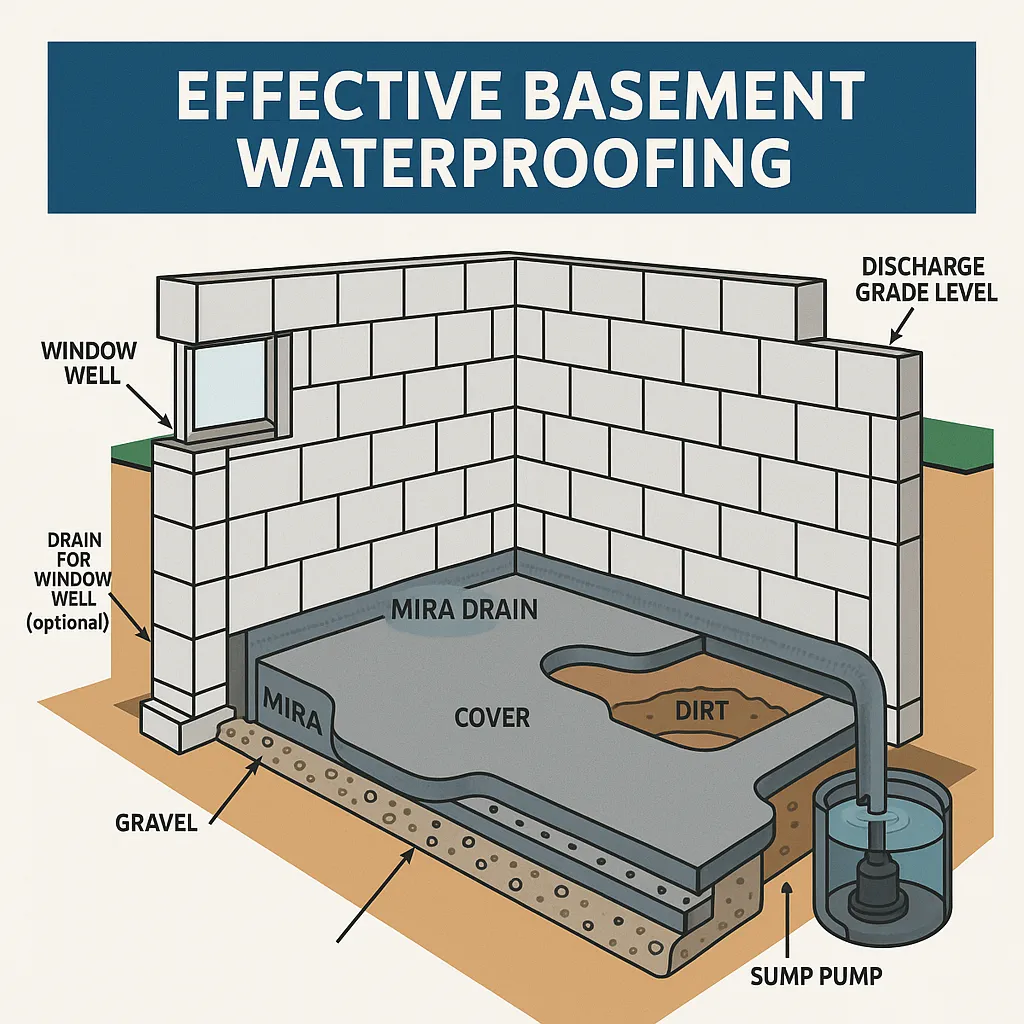
Interior waterproofing works by collecting water that reaches or passes through foundation walls and channelling it to an internal drainage system—usually a perforated pipe in a gravel bed leading to a sump pit and pump—thus relieving hydrostatic pressure and preventing water accumulation on the floor. Exterior waterproofing prevents water from contacting the foundation by excavating to the footing, repairing cracks, and applying membranes or coatings along with exterior drain tile to divert groundwater away; this addresses the source before water can press against the wall. Interior methods are typically less invasive and more economical in retrofit scenarios where landscaping or access is constrained, while exterior systems often offer a more permanent barrier but at higher cost and disruption. Both approaches can be complementary: exterior measures reduce load on interior systems, and interior drainage provides a reliable last line of defense when exterior mitigation is impractical. The table above helps homeowners weigh these characteristics when deciding which method or combination suits their property.
How Does Foundation Crack Repair Prevent Further Water Damage?
Foundation crack repair prevents water intrusion by sealing pathways through which hydrostatic or gravity-driven water enters and by restoring the structural integrity of the wall where necessary; many techniques are available depending on crack type and activity. Epoxy and polyurethane injections are commonly used to stop leaks—epoxy to restore structural strength and polyurethane to seal active water leaks by expanding into voids—while hydraulic cement can provide quick surface sealing for emergent weeps. For cracks caused by movement or significant structural issues, repairs may include stitching, carbon fiber straps, or other reinforcement to resist ongoing loads while drainage is improved to reduce the forces causing the movement. Timely repair of foundation cracks reduces long-term costs by preventing moisture-driven deterioration of materials, mold growth, and progressive structural damage; the next section explains interior French drains in detail to illustrate a common complementary measure.
How Does an Interior French Drain System Protect Your Basement?
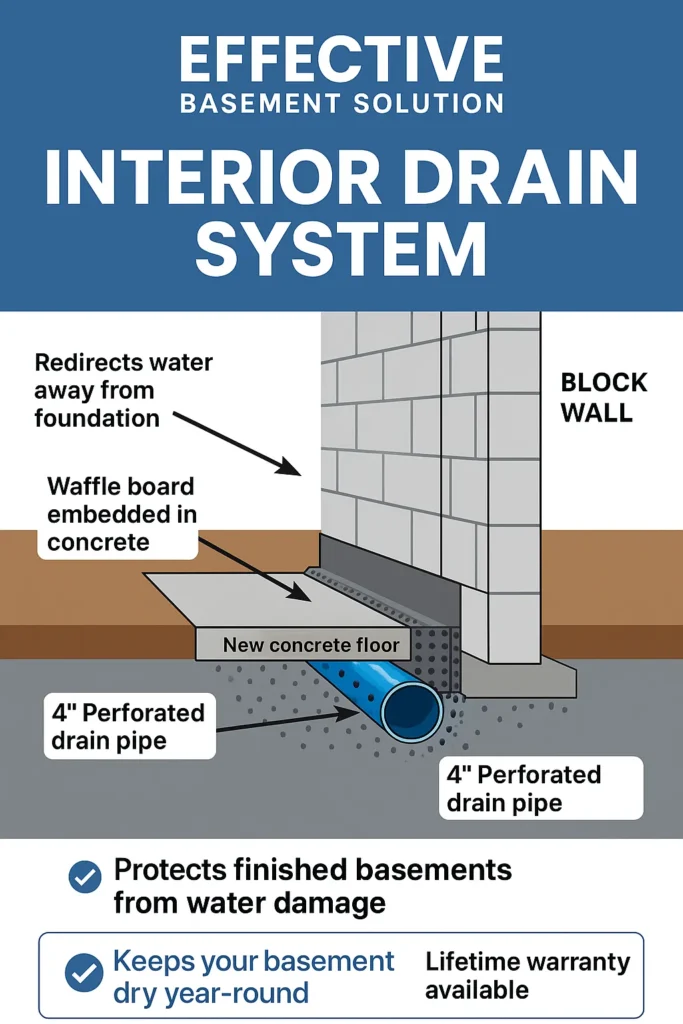
An interior French drain system protects basements by collecting groundwater that reaches the foundation perimeter, channeling it through a perforated pipe set in an aggregate bed, and directing the water to a sump pit where a pump expels it away from the foundation—this three-step mechanism (collect → channel → pump) relieves hydrostatic pressure and prevents floor and wall seepage. The system’s components—perforated drain tile, gravel or aggregate, filter fabric, and a sump pit with a reliable pump—work together to intercept subsurface flows before they pool in the slab or migrate through masonry pores. When properly designed for local soil permeability and water table behavior, interior French drains are very effective at stabilizing basement moisture levels and reducing episodic flooding. Maintenance involves occasional inspection of the sump pump, cleaning of screens where applicable, and monitoring for sediment that can reduce drain capacity; paired with a battery backup pump, interior French drains provide robust protection during storm-related power interruptions. The following H3 sections describe components and Short Hills cost/installation considerations.
What Is an Interior French Drain System and How Does It Work?
An interior French drain system consists of a shallow trench along the interior perimeter of the basement slab, a layer of gravel that creates a conduit for water, a perforated pipe that collects the water, and a sump pit that receives the flow for mechanical discharge; together these elements intercept groundwater and direct it to a controlled outlet. The mechanism is straightforward: groundwater entering the wall or raising beneath the slab flows into the gravel bed, enters the perforated pipe, and flows by gravity to the sump pit where a pump expels it beyond the home’s foundation envelope. This system effectively reduces hydrostatic pressure by lowering the groundwater level immediately adjacent to the foundation and prevents the slow seepage that creates efflorescence and mold. Proper installation requires attention to grade within the trench, filter fabric to prevent clogging by fines, and a correctly sized sump pump matched to expected inflow; routine testing of the pump ensures continued protection. Understanding this mechanism clarifies why French drains paired with sump pumps are a mainstay for wet-basement solutions.
What Are the Cost and Installation Benefits of French Drain Systems in Short Hills NJ?
In Short Hills and similar New Jersey communities, the cost and installation benefits of interior French drain systems reflect local soil types, water table depths, and typical home access constraints; interior installation is often preferred where exterior excavation would disrupt landscaping or be impractical. Typical cost drivers include floor removal length, ease of access to the perimeter, presence of obstructions (utilities, stairs), and soil conditions that affect excavation and disposal; clay soils that hold moisture increase the necessity of robust drainage but may complicate exterior excavation, favoring interior solutions. Interior French drains are generally less expensive and less disruptive than full exterior excavation because they avoid major landscaping and tree-root interference while still providing effective hydrostatic relief; in many Short Hills cases, the ROI appears quickly when balanced against recurring remediation costs from repeated seepage. Homeowners should factor in pump capacity and potential battery backup, and consider that professional installation by a licensed in-house crew familiar with local conditions can reduce the chance of rework. If uncertainty remains about access or soil behavior, a free inspection helps determine whether an interior French drain or an exterior membrane plus drain is the best local match.
The following table summarizes localized cost and installation factors for Short Hills, New Jersey, and typical values that influence French drain selection.
Localized Short Hills factors that affect French drain pricing and installation.
| Factor | Attribute | Typical Value (Short Hills NJ) |
|---|---|---|
| Soil Type | Clay presence increases lateral pressure | Moderate to High |
| Access | Interior slab removal vs exterior excavation | Often interior preferred |
| Water Table | Seasonal fluctuation after storms | Variable; can be high |
| Landscaping Impact | Risk to mature trees and lawns | Moderate to High |
| Typical Disruption | Interior trenching within basement | Moderate; faster restoration |
Why Is Sump Pump Installation Essential for Wet Basement Solutions in New Jersey?
Yes—sump pump installation is essential for many wet-basement solutions in New Jersey because pumps actively remove collected water, prevent accumulation at the lowest point, and reduce hydrostatic pressure on foundation systems, especially where groundwater and runoff converge near the home. Sump pumps transform passive drainage collection into active removal by discharging water away from the foundation, thereby lowering the immediate subsurface water table and protecting interior spaces from episodic flooding and continuous seepage. Battery backup systems further enhance essential protection by ensuring pump operation during storm-related power outages when pumps are most needed; selecting appropriate pump type and backup capacity is therefore a critical design choice for NJ homes. The next subsections explain pump mechanics and the advantages of battery backup strategies to guide homeowner decisions about specifications and maintenance.
How Does a Sump Pump Remove Water and Prevent Flooding?
A sump pump removes water by sensing the water level in a sump pit and activating a motor-driven impeller that forces water through a discharge pipe away from the building envelope; proper installation includes a check valve to prevent backflow and a discharge route that avoids returning water to the foundation perimeter. Submersible pumps sit inside the sump pit and are quiet and space-efficient, while pedestal pumps have their motor above the pit and the pumping element below, offering easier service access; each has trade-offs in lifespan, noise, and clog tolerance. Correct sizing matches pump flow rate (gallons per minute) to expected inflow during peak events and ensures the discharge line and check valve prevent recycled infiltration; improper discharge routing or undersized pumps are common failure modes that leave homes vulnerable during heavy storms. Routine maintenance—testing operation, inspecting check valves, and clearing debris—keeps pumps reliable, and pairing a sump pump with perimeter drainage or a French drain improves overall system performance.
What Are the Benefits of Battery Backup Sump Pumps for Continuous Protection?
Battery backup sump pumps provide continuous protection when grid power fails, which is crucial during storms that both increase water inflow and cause electrical outages; a backup pump switches on automatically when primary power is lost and runs from a dedicated battery or battery bank to maintain discharge capacity. Backup runtime depends on battery capacity and pump draw and should be selected based on typical storm duration and expected inflow; homeowners often size backups to provide several hours of continuous operation at peak pump draw to bridge short outages or until power is restored. Regular battery maintenance—checking terminals, ensuring charge, and replacing batteries on schedule—ensures the backup will perform when needed, and some homeowners choose combination systems with automatic transfer switches that manage primary and backup pumps seamlessly. For New Jersey properties where storms and power interruptions are common during high-precipitation events, battery backup systems significantly reduce flood risk and the chance of pump failure-related damage.
The table below compares common sump pump specifications and recommended backup options for New Jersey home conditions.
| Pump Type | Characteristic | Recommended Spec/Value |
|---|---|---|
| Submersible | Enclosed motor, quiet | 1/3–1 HP for typical homes |
| Pedestal | Motor above pit, easier service | 1/4–1/3 HP for low-clog environments |
| Battery Backup | Runtime depends on battery amp-hours | 12–24 V AGM or deep-cycle battery sized to runtime |
| Check Valve | Prevents backflow | Reliable, low-head loss valve |
| Discharge Routing | Must direct water away from foundation | Minimum 10–20 feet or to approved drain |
How Can Crawl Space Encapsulation and Dehumidification Improve Basement Moisture Control?
Crawl space encapsulation and basement dehumidification improve moisture control by creating a barrier against ground moisture and by actively managing interior relative humidity to levels that discourage mold and material degradation. Encapsulation involves installing a continuous vapor barrier across the crawl space floor and walls, sealing vents, and often adding conditioned air or dehumidification to reduce the space’s moisture load; this prevents moist air from infiltrating the living space above and reduces humidity-driven structural issues. Dehumidifiers sized to the space maintain target relative humidity—generally under 50%—and prevent condensation on cold surfaces, which limits mold growth and improves indoor air quality. Integrating encapsulation with drainage improvements and foundation repairs creates a comprehensive moisture-control strategy that addresses both sources and pathways of moisture, and routine maintenance ensures systems continue delivering the expected benefits.
What Are the Advantages of Crawl Space Encapsulation for New Jersey Homes?
Crawl space encapsulation brings multiple advantages for New Jersey homes where humid summers and variable soil moisture can feed basement and subfloor dampness: it reduces moisture migration into the living space, limits mold and pest entry, and stabilizes floor joist conditions that otherwise degrade over time. Encapsulation also improves energy efficiency by allowing HVAC systems to operate with more stable indoor conditions and by reducing cold-floor draft issues, and sealed crawl spaces often simplify ductwork conditioning, which can cut heating and cooling load. Materials selection—thick vapor barrier, sealed seams, and insulated perimeter—matters for durability in humid climates and freeze-thaw conditions common in NJ; professional installation ensures continuous sealing and appropriate termination at foundation walls. When combined with proper exterior grading and interior drainage, encapsulation helps create a predictable, dry building envelope that supports both structural longevity and healthier indoor air.
How Do Dehumidification Systems Help Maintain a Dry and Healthy Basement?
Dehumidification systems remove excess moisture from basement air through refrigeration or desiccant processes, lowering relative humidity and preventing condensation, mold growth, and musty odors that accompany chronic dampness. Effective sizing links capacity (pints per day) to space volume and expected moisture influx, with continuous drainage options (condensate pumps or gravity drains) recommended to avoid manual emptying; correct placement promotes airflow and avoids dead zones where humidity can remain high. Regular maintenance—cleaning filters, checking drainage paths, and verifying condensate removal—ensures peak performance and extends system life, while monitoring using a hygrometer confirms that RH targets (often 45% or lower) are being sustained. In many New Jersey basements, dehumidifiers complement drainage systems by handling evaporative and condensation loads that drainage alone cannot address, producing a comprehensive moisture-control outcome.
Why Choose Effective Basement Solutions for Your New Jersey Basement Waterproofing Needs?
Effective Basement Solutions differentiates its services for New Jersey homeowners through a licensed in-house crew model, a full menu of waterproofing and foundation repair options tailored to local conditions, and a free inspection process that documents findings and recommends prioritized solutions. The company emphasizes comprehensive approaches—interior French drains, sump pump installation (including battery backup), foundation crack repair, crawl space encapsulation, and dehumidification—deployed by technicians trained to diagnose hydrostatic pressure, efflorescence indicators, and local soil impacts specific to NJ. Homeowners seeking clarity on repair options benefit from the company’s in-house expertise because it reduces handoffs between assessors and installers, streamlines accountability, and typically simplifies warranty and follow-up support. The next subsections explain how local experience and customer feedback themes translate into measurable homeowner benefits and outline typical warranty and trust signals homeowners can request during the inspection process.
How Does Over 20 Years of Experience Benefit New Jersey Homeowners?
More than two decades of hands-on experience in basement waterproofing and foundation repair within New Jersey allows a provider to refine methods, anticipate local challenges such as clay soils and freeze-thaw cycles, and optimize solutions for neighborhood-specific conditions like Short Hills property characteristics. Long-term local experience informs better diagnostic judgment—recognizing patterns of seasonal water table rise, common grading mistakes, and typical failure modes of makeshift repairs—so interventions are more likely to resolve root causes rather than mask symptoms. Experienced teams also accumulate institutional knowledge about effective pump sizing, appropriate membrane treatments, and the most durable materials for local climates, which reduces callbacks and produces more consistent long-term outcomes for homeowners. This practical knowledge complements formal licensing and training, producing a combination that improves reliability and homeowners’ confidence in repair longevity.
What Do Customers Say About Our Waterproofing Services and Warranty?
While individual testimonials should be drawn from verified customer sources, common themes that reinforce quality waterproofing service include responsiveness during inspection scheduling, clarity of written reports and recommended solutions, visible improvement in dryness after installation, and straightforward warranty coverage that protects against workmanship and system failures. Homeowners evaluating contractors should request documented testimonials, case examples, and explicit warranty terms during the free inspection so they can compare commitments across providers and ensure coverage matches the scope of the work performed. Effective Basement Solutions encourages prospective clients to review documented examples of before-and-after outcomes and to ask about the specifics of workmanship and component warranties that accompany installations; these discussions help homeowners judge whether the recommended approach aligns with long-term protection goals. Clear warranty language, accessible documentation, and consistent follow-through after installation are key trust signals that homeowners should seek when selecting a provider.
- Key reasons to request an inspection and compare options:Document the source: An inspection identifies whether water is entering due to hydrostatic pressure, drainage failures, or interior plumbing.
Compare approaches: A professional evaluation allows comparison of interior vs exterior solutions and cost/benefit trade-offs.
Clarify maintenance needs: Understanding pump and system upkeep helps plan lifecycle costs. - Service offerings commonly matched to diagnosed needs:Interior French Drain System: For hydrostatic relief and internal water collection.
Sump Pump Installation with Backup: For active water removal and outage resilience.
Foundation Crack Repair and Structural Reinforcement: For stopping active leaks and restoring stability.
This article has outlined signs, causes, diagnostics, and proven solution types for basement water problems in New Jersey, and it provided concrete guidance on inspection expectations, local cost factors, and how to evaluate service options. For homeowners ready to move from diagnosis to action, requesting a professional assessment is the next step to define a tailored scope and secure a durable, warrantied waterproofing solution.
Frequently Asked Questions
1. What are the long-term benefits of basement waterproofing?
Investing in basement waterproofing offers numerous long-term benefits, including enhanced property value, improved indoor air quality, and reduced risk of mold and structural damage. By preventing water intrusion, homeowners can avoid costly repairs associated with water damage and maintain a healthier living environment. Additionally, waterproofing can lead to lower energy costs by improving insulation and reducing humidity levels. Over time, these benefits contribute to a more comfortable and safe home, making waterproofing a wise investment for any homeowner.
2. How often should I inspect my basement for water issues?
Homeowners should inspect their basements at least twice a year, ideally in spring and fall, to catch any potential water issues early. After heavy rainfall or snowmelt, it’s also wise to conduct a thorough check. Look for signs of moisture, such as efflorescence, mold, or water stains, and monitor any cracks in the foundation. Regular inspections help identify problems before they escalate, allowing for timely repairs and maintenance, which can save homeowners significant costs in the long run.
3. Can I perform basement waterproofing myself, or should I hire a professional?
While some minor waterproofing tasks, like sealing small cracks or applying waterproof paint, can be done by homeowners, most comprehensive waterproofing solutions require professional expertise. Professionals have the necessary tools, experience, and knowledge to assess the specific needs of your basement and implement effective solutions. Hiring a licensed contractor ensures that the work meets local building codes and standards, providing peace of mind and long-term protection against water damage.
4. What is the average cost of basement waterproofing in New Jersey?
The average cost of basement waterproofing in New Jersey varies widely based on factors such as the size of the basement, the severity of the water issues, and the chosen waterproofing method. Homeowners can expect to pay anywhere from $1,500 to $10,000 or more for comprehensive solutions. Interior systems tend to be more cost-effective than exterior excavation methods. It’s advisable to obtain multiple quotes from licensed contractors to compare services and ensure you receive a fair price for the work needed.
5. How can I maintain my waterproofing system after installation?
Maintaining your waterproofing system is crucial for its long-term effectiveness. Regularly check and clean sump pumps, ensuring they are functioning properly and that discharge lines are clear. Inspect the interior and exterior drainage systems for blockages or damage, and monitor humidity levels in the basement. Additionally, schedule periodic professional inspections to assess the system’s performance and address any potential issues before they become significant problems. Proper maintenance can extend the life of your waterproofing solutions and protect your home from water damage.
6. What should I do if I notice water in my basement after waterproofing?
If you notice water in your basement after waterproofing, it’s essential to act quickly. First, identify the source of the water intrusion—check for new cracks, leaks, or drainage issues. Document the situation with photos and notes for reference. Contact your waterproofing contractor to discuss the issue; they may offer a warranty or guarantee for their work. A professional assessment can help determine if additional measures are needed to address the problem effectively and prevent future occurrences.
7. Are there any specific waterproofing methods recommended for older homes?
Older homes often require specialized waterproofing methods due to unique structural challenges and potential historical preservation concerns. Techniques such as interior French drains, sump pump systems, and foundation crack repairs are commonly recommended. Additionally, exterior waterproofing methods may involve careful excavation to avoid damaging existing landscaping or structures. Consulting with a contractor experienced in working with older homes is crucial, as they can tailor solutions to meet the specific needs of the property while adhering to local regulations and preservation guidelines.
Conclusion
Addressing basement water problems in New Jersey is essential for maintaining structural integrity and ensuring a healthy living environment. By understanding the signs, causes, and effective waterproofing solutions, homeowners can make informed decisions that protect their property long-term. Taking the first step with a professional inspection can clarify the best course of action tailored to individual needs. Contact Effective Basement Solutions today to schedule your free assessment and secure your home against moisture issues.
