
When to Get a Foundation Inspection: Key Signs, Costs & Repair Options
A foundation inspection is a professional structural assessment that evaluates the condition of a home’s footing, slab, and basement walls to detect settlement, lateral movement, cracks, and water entry before problems escalate. Early inspection matters because detecting a developing issue early reduces repair complexity, limits moisture-related damage, and preserves property value and occupant safety. This guide explains when to schedule an inspection, the common visual and functional signs to watch for, and how local New Jersey conditions like expansive clay and heavy seasonal rain influence foundation performance. Homeowners will learn what inspectors look for, how inspections are conducted, which repair methods address specific failure modes, and realistic cost ranges for the region. The article also explains when to involve a structural engineer versus a foundation repair specialist and outlines practical next steps, including low-friction options for evaluation and follow-up. Throughout, keywords like foundation inspection, foundation repair, foundation inspection cost NJ, and basement foundation inspection New Jersey are used to help New Jersey homeowners find timely, actionable guidance.
What Are the Most Common Signs You Need a Foundation Inspection?
A clear sign you need a foundation inspection is persistent, observable change in the building that suggests structural movement or moisture intrusion. Visual indicators, functional disturbances, and recurring moisture problems all point to potential foundation stress that merits a professional assessment. Detecting these signs early helps prevent progressive deterioration and reduces the chance of needing invasive underpinning later. Read the specific symptom descriptions below to decide whether to call a qualified inspector for a diagnostic visit.
Which Types of Foundation Cracks Indicate Structural Damage?
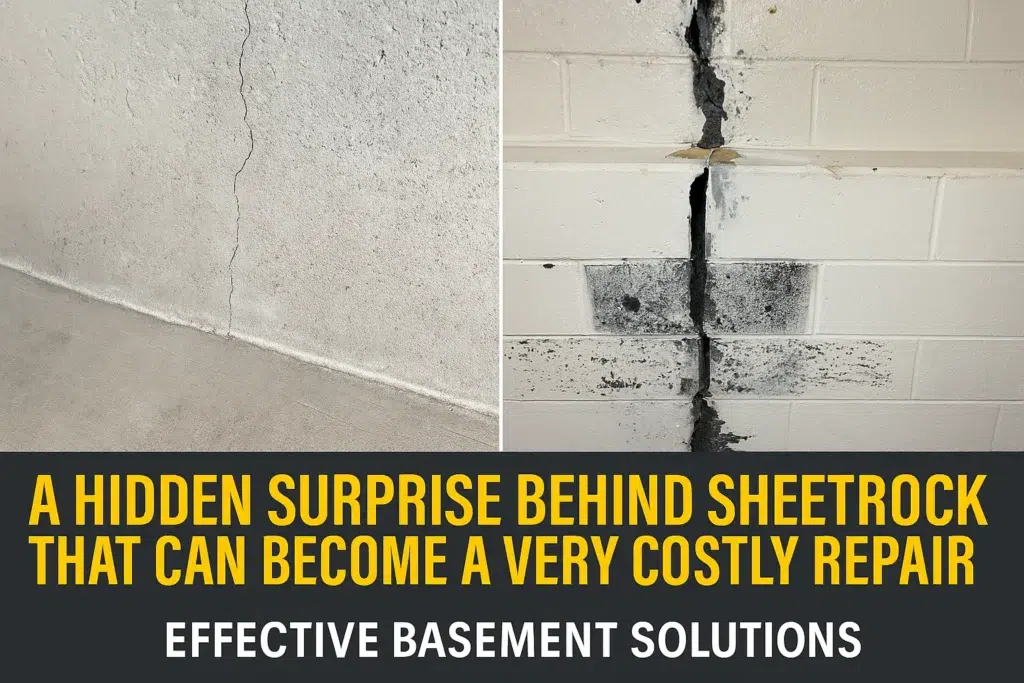
Certain crack patterns signal structural concern rather than simple cosmetic shrinkage, so understanding the morphology helps prioritize inspection urgency. Stair-step cracks in brick or block masonry often indicate differential settlement between foundation segments and usually require an assessment for underpinning or stabilization. Horizontal cracks in basement walls are commonly caused by lateral soil pressure and can be a high-risk indicator of wall bowing; they typically require reinforcement such as carbon fiber or steel solutions. Vertical cracks can be benign hairlines caused by shrinkage but may indicate settlement if they are wide, displaced, or accompanied by other symptoms. Monitor and photograph cracks, measure width over time with a ruler or crack gauge, and document any progression—this monitoring helps the inspector determine timing and severity for repair.
How Do Bowing Walls and Uneven Floors Signal Foundation Issues?
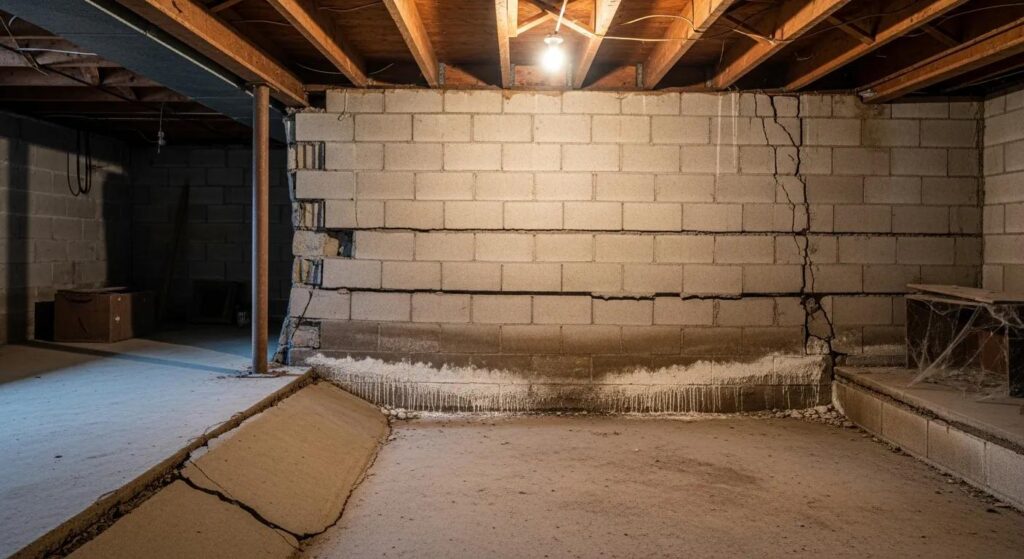
Bowing or bulging basement walls result from lateral soil pressure and hydrostatic forces pushing against the wall, and these movements progressively compromise the wall’s load-bearing role. Uneven or sloping floors commonly accompany differential settlement; as one footing sinks relative to another, floors develop noticeable grades and doors or windows may stick or fail to latch. Measure wall deflection and floor slope with simple tools—a straightedge and level or smartphone inclinometer—to track changes between inspections. If deflection exceeds small, steady thresholds or if floors become noticeably out of level, stabilize the structure promptly to prevent escalating repair costs and to maintain resale value.
What Moisture-Related Problems Suggest a Foundation Checkup?
Recurring basement dampness, visible efflorescence on masonry, persistent musty odors, and repeated mold patches indicate that water is reaching or saturating the foundation system rather than only superficial condensation. Hydrostatic pressure driven by poor grading, clogged gutters, or high groundwater forces water through cracks and joints, accelerating masonry deterioration and undermining soil support beneath footings. Immediate homeowner steps include improving surface drainage, ensuring gutters and downspouts direct water away from the foundation, and running a dehumidifier while scheduling an inspection. Persistent water intrusion tied to structural cracks or sustained hydrostatic pressure is a clear trigger for a full foundation inspection and possible combined waterproofing work.
What Causes Foundation Problems in New Jersey Homes?
Foundation problems in New Jersey are frequently driven by local soil behavior, climatic patterns, and site drainage practices that create settling or lateral pressure against foundation elements. Expansive clay soils common in parts of the state swell when wet and contract when dry, creating repeated stress cycles on footings and slabs. Heavy seasonal rains and poor surface drainage increase hydrostatic pressure behind basement walls, which promotes cracks and bowing. Understanding these causes helps homeowners prioritize corrective measures that address the root mechanism rather than just the visible symptom.
How Does Soil Movement and Hydrostatic Pressure Affect Foundations?
Soil movement affects foundations through volumetric changes and loss of support; expansive clay swells with moisture uptake and shrinks when dry, producing uplift and settlement that stresses footings and slabs. Hydrostatic pressure is the force of water in the soil pushing against basement walls and under slabs; when pressure exceeds structural resistance, walls can crack, bow, or displace. These mechanisms often act together in New Jersey after intense storms or rapid seasonal moisture shifts, so inspectors evaluate both soil conditions and moisture pathways to recommend combined repair and waterproofing solutions. Addressing drainage and groundwater control frequently reduces the driving forces responsible for recurring structural stress.
Expansive Clay Soils and Foundation Damage: The Impact of Drainage
The detrimental impact of inadequate drainage, particularly the ponding of roof runoff water adjacent to a structure, represents the most adverse scenario for expansive clay soils. This condition can induce soil swelling, thereby exerting pressure on the foundation and leading to structural distress. Effective drainage systems and appropriate site grading are paramount to preclude water accumulation around the foundation.
Study of expansive soils and residential foundations on expansive soils in Arizona, CE Zapata, 2011
What Role Do Drainage Issues and Tree Roots Play in Foundation Damage?
Surface drainage failures—poor grading, blocked gutters, and downspouts that dump water near the foundation—concentrate moisture at the foundation perimeter and elevate hydrostatic loading. Conversely, large tree roots can alter local soil moisture by drawing water away or physically displacing soil, resulting in localized settlement or heaving near foundations. Preventative measures include regrading to promote positive slope away from the house, maintaining gutter systems, and situating large trees a safe distance from foundation lines. When drainage and roots have already contributed to noticeable movement or leaks, the inspection will evaluate whether settling, underpinning, or moisture-control systems such as French drains or sump pumps are necessary.
Basement Wall Failure: Causes Related to Soil and Hydrostatic Pressure
The west basement wall supporting the living room exhibited inward bowing. The load acting upon this wall is the combined pressure exerted by soil and hydrostatic forces, both of which are lateral loads. The observed bowing of the wall signifies that the lateral pressure from the soil and water exceeded the structural capacity of the wall.
The Leaking Basement Epidemic—Causes, Cures and Consequences, 2006
How Is a Professional Foundation Inspection Conducted?
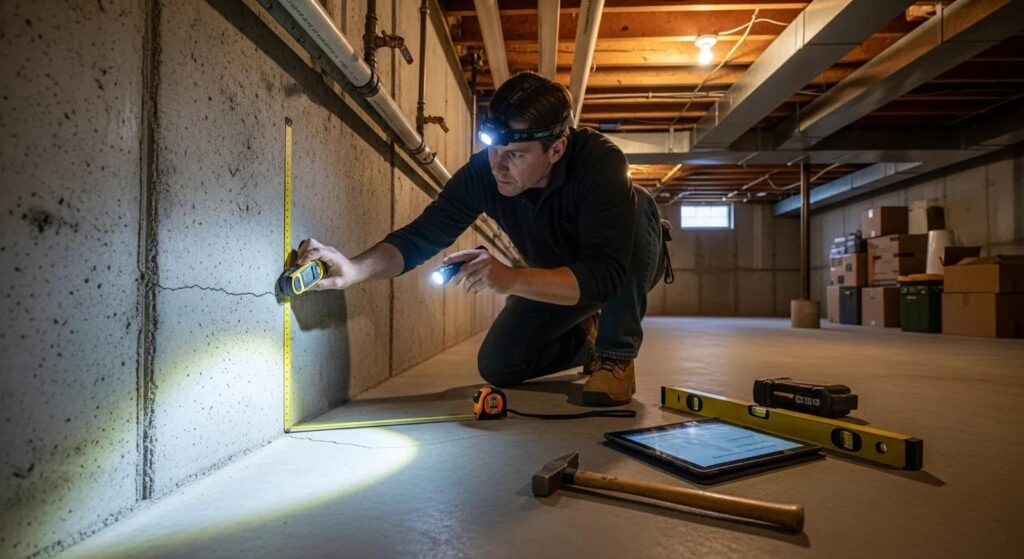
A professional foundation inspection is a structured sequence: visual survey, measured diagnostics, moisture testing, and a written recommendation that ranks urgency and outlines repair options. Inspectors use targeted tools to quantify movement and moisture, synthesize findings into a practical diagnosis, and propose repairs that match the observed failure mechanisms. A concise report helps homeowners prioritize remediation and understand long-term outcomes for different repair approaches. Below is a step-by-step summary of a standard inspection workflow followed by a table that clarifies stages, tools, and expected outcomes.
- Visual exterior and interior survey to spot cracks, settlement, and drainage issues.
- Measurement and monitoring using levels, inclinometers, and crack gauges to quantify movement.
- Moisture diagnostics with meters and, where needed, controlled water tests to identify hydrostatic routes.
- Report generation with photos, urgency rating, and recommended next steps including whether engineering input is needed.
Inspectors typically synthesize these steps into a clear recommendation that differentiates immediate structural concerns from moisture-only issues, guiding homeowners on whether stabilization, waterproofing, or combined approaches are necessary.
The inspection workflow below summarizes stages, the tools commonly used, and what homeowners should expect in terms of outcomes and timing.
| Stage | Tools / What Inspector Looks For | Expected Outcome / Typical Duration |
|---|---|---|
| Visual Survey | Crack patterns, wall deflection, grading | Preliminary diagnosis and photo documentation; 30–60 minutes |
| Measurement & Monitoring | Levels, crack gauges, inclinometer | Quantified movement data and trend indicators; 30–90 minutes |
| Moisture Testing | Moisture meters, flashlight inspection, water tests | Identification of water pathways and hydrostatic pressure points; 30–60 minutes |
| Reporting & Recommendation | Photos, annotated diagrams, urgency ranking | Written report with repair options and timeline estimate; 1–3 days deliverable |
This table clarifies that a thorough inspection combines visual cues with instrumented measurements to deliver a prioritized repair plan rather than a one-size-fits-all prescription. The next section discusses what homeowners should expect during the inspection visit itself.
Effective Basement Solutions conducts inspections that follow the same diagnostic stages outlined above, and homeowners should expect a thorough, no-pressure evaluation. As a operating in New Jersey, Effective Basement Solutions offers free inspections and deploys a licensed, in-house crew (no subcontractors) to perform assessments and follow-up work. Their inspection process produces a documented report with photos, measured observations, and recommended repair pathways so homeowners can decide without any sales pressure. If structural reinforcement or waterproofing is required, the report will link inspection findings to the appropriate repair methods.
What Are the Most Effective Foundation Repair Methods After Inspection?
Effective repairs match the method to the failure mode identified during inspection: carbon fiber and steel bracing for lateral wall movement, underpinning (pier systems) for settlement and sinking footings, and epoxy or polyurethane injections for non-structural cracks and water sealing. Repair selection depends on what the inspection measured—lateral deflection, vertical settlement, or isolated water leaks—and on long-term protection goals such as preserving structural safety and preventing moisture recurrence. Below is a concise comparison table (Entity | Attribute | Value) that helps homeowners weigh typical repair options against the issues they address and relative invasiveness.
| Repair Method | Primary Use / What It Fixes | Invasiveness & Typical Cost Range |
|---|---|---|
| Carbon fiber wall reinforcement | Corrects moderate wall bowing and resists lateral pressure | Low interior disturbance; long lifespan; moderate cost |
| Steel I-beam bracing | Provides strong compression/bracing for significant wall movement | Higher disturbance where braces are installed; durable; moderate–high cost |
| Underpinning (helical/push piers) | Stabilizes settling or sinking footings and restores grade-level support | Excavation needed at perimeter; permanent stabilization; high cost |
| Epoxy/polyurethane crack injection | Seals non-structural cracks and stops water infiltration | Low invasiveness; quick cure; lower cost for non-structural repairs |
This table shows which methods suit common failure modes and indicates invasiveness and relative cost, helping homeowners choose an approach that balances durability and budget. The following subsections explain mechanics of popular reinforcement methods and when deeper underpinning is required.
How Do Carbon Fiber Straps and Steel I-Beams Reinforce Foundations?
Carbon fiber straps function as tension reinforcements that bond directly to masonry surfaces to resist further outward movement; their high tensile strength and thin profile allow installation with minimal interior disruption. Steel I-beams act as compression and bracing elements that transfer loads and physically restrain a bowed wall, suitable where bracing force must be substantial. Carbon fiber is less invasive and often faster to install, while steel I-beams deliver robust resistance for larger deflections; both methods, when properly designed, extend a wall’s effective service life and integrate with waterproofing solutions. Choosing between them depends on measured deflection, wall condition, and long-term maintenance preferences.
When Is Underpinning or Crack Repair Recommended?
Underpinning with piers—helical or push types—addresses vertical settlement by transferring load to deeper, stable strata or engineered bearing layers, restoring structural support to sinking footings. It is recommended when inspections document progressive settlement, non-level floors, or foundation segments that no longer bear design loads. Epoxy or polyurethane injection is appropriate for non-structural cracks where the primary goal is water sealing rather than load restoration and is often combined with drainage improvements for long-term effectiveness. Frequently, a combined approach—underpinning for structural support plus perimeter waterproofing for moisture control—provides the most durable solution.
Properties of Expansive Clay Soils and Their Impact on Foundations
The density of expansive clay soils or bedrock significantly influences the magnitude of volume change and the developed pressures. Higher density correlates with greater volume change and increased pressure development. Figure 1 illustrates the cracking effects resulting from soil expansion on a major highway in Arizona.
Expansive clays–properties and problems, 1959
Effective Basement Solutions offers structural reinforcement services that include carbon fiber wall strengthening, steel I-beam bracing, and precision underpinning as part of comprehensive foundation repair options. When inspection data indicate lateral wall stress or settlement, these solutions are presented with explanations of expected outcomes and integration with waterproofing work to protect the home long-term.
How Much Does a Foundation Inspection and Repair Cost in New Jersey?
Understanding cost begins with recognizing the main drivers: inspection scope, extent of structural damage, soil and access conditions, and whether additional waterproofing or permits are required. A typical diagnostic inspection is affordable relative to repair costs and clarifies whether a simple crack injection or a full underpinning strategy is necessary. New Jersey homeowners should view inspection cost as an investment that informs accurate repair estimates and prevents unnecessary or incomplete fixes. The sections below break down cost drivers and present typical regional price ranges to help set expectations.
What Factors Influence Foundation Inspection and Repair Costs?
Several variables change price: the depth and breadth of diagnostic testing (simple visual survey versus instrumented monitoring), the complexity of recommended repairs (crack injection vs. pier installation), the presence of expansive soils that require deeper or heavier solutions, and site access or landscaping that increases labor and equipment time. Permits, structural engineering reports, and integration with waterproofing (French drains, sump systems) also add to overall project budgets. For example, limited-scope crack repairs generally have low material and labor costs, while underpinning and major wall stabilization require excavation, heavy equipment, and specialized crews that drive up costs substantially.
- Inspection depth and testing requirements increase initial fees.
- Repair complexity (piers vs. injections) largely determines labor and equipment costs.
- Site access, landscaping removal, and permit needs add to total project cost.
These drivers explain why homeowners should obtain a clear inspection report and multiple estimates before choosing a repair pathway; the next subsection provides typical NJ ranges to frame expectations.
| Item | Cost Driver | Example Range / Impact |
|---|---|---|
| Diagnostic inspection | Scope and equipment used | Modest relative fee; essential for accurate quotes |
| Crack repair (injection) | Crack type and length | Lower cost; often completed in a day |
| Wall reinforcement (carbon fiber/steel) | Deflection magnitude and labor | Moderate cost; multi-day work if multiple walls |
| Underpinning (piers) | Depth, pier type, excavation | High cost; permanent stabilization but highest expense |
| Waterproofing systems | Perimeter drains, sump, discharge | Adds to project but reduces recurrence risk |
This breakdown clarifies that inspection fees are small compared with major structural solutions and that combined waterproofing substantially reduces long-term moisture-driven costs. After seeing estimated ranges, homeowners commonly request a free inspection to obtain a tailored written estimate.
What Is the Average Price Range for Foundation Services in NJ?
Average price ranges depend on repair type and site specifics; inspection fees are typically small compared to repair scope, and minor crack repairs cost a fraction of underpinning or full wall stabilization. Small-scale epoxy or polyurethane crack sealing and interior drainage can often be completed at a moderate cost and are appropriate for non-structural leaks. Moderate repairs—carbon fiber reinforcement or steel bracing—are costlier but address more serious lateral movement, while major solutions like underpinning entail the highest expense due to excavation and specialized piers. Because of wide variability driven by soil and access, homeowners should use inspection-based estimates for budgeting rather than relying solely on generic averages.
Why Choose Effective Basement Solutions for Your Foundation Inspection and Repair?
Effective Basement Solutions presents clear local advantages for New Jersey homeowners seeking low-friction assessment and durable repairs grounded in structural best practices. The company emphasizes being a LocalBusiness with a licensed, in-house crew (no subcontractors), offering free inspections, and operating with no sales pressure—factors that reduce homeowner risk and increase transparency during evaluation and repair. Their service menu covers basement waterproofing, sump pump installation, French drain installation, crawl space encapsulation, dehumidification systems, battery backup pumps, and structural reinforcement including carbon fiber wall strengthening, steel I-beam bracing, and precision underpinning. For homeowners prioritizing long-term protection and a dry, healthy basement, this combination of diagnostic clarity and integrated service capability supports comprehensive outcomes.
What Are the Benefits of Our Licensed In-House Crew and Free Inspections?
Using a licensed, in-house crew ensures consistent quality control, clear accountability on repair decisions, and streamlined communication across inspection and remediation phases. Free inspections reduce homeowner friction by delivering a no-cost, documented assessment that outlines urgency, repair alternatives, and estimated timelines without any sales pressure. Homeowners benefit from coordinated planning when structural reinforcement and waterproofing are both recommended, because in-house teams can sequence work to minimize disruption and ensure compatibility between systems. This approach supports informed decisions and long-term structural safety for New Jersey properties.
How Do Our Structural Reinforcement Services Protect Your Home Long-Term?
Structural reinforcement methods—carbon fiber wall strengthening, steel I-beam bracing, and underpinning—restore and preserve load paths, limit future movement, and prolong the service life of foundation elements when chosen and installed based on inspection data. When paired with effective waterproofing and drainage measures such as French drains and sump pump systems, reinforcement reduces the chance of moisture-driven recurrence and contributes to stable interior conditions that prevent mold and material deterioration. By combining diagnostics, reinforcement, and moisture control, homeowners achieve a comprehensive strategy that prioritizes long-term protection, structural safety, and a dry, healthy basement.
- Request a free inspection from Effective Basement Solutions to get a documented report and an estimate without pressure.
- Review recommended repairs in the inspection report and compare options for structural reinforcement and waterproofing.
- Plan integrated work so that stabilization and drainage improvements are coordinated to prevent recurrence.
These next steps help homeowners move from diagnosis to durable remediation while preserving property value and safety.