
Cliffside Park, NJ Basement Waterproofing: Interior French Drains
Wet basements are a common and consequential problem in Cliffside Park NJ, where local topography and seasonal precipitation combine to raise groundwater pressure against foundation walls. This article explains the root causes homeowners face, the most effective waterproofing and foundation repair strategies, realistic cost expectations, and the long-term energy and health benefits of proper moisture control. You will learn how hydrostatic pressure forces water into basements, how interior French drains and sump pump systems work, when exterior excavation or foundation stabilization is required, and why crawl space encapsulation improves humidity control and energy efficiency. The guide also provides actionable inspection checklists, clear criteria for choosing interior versus exterior systems, transparent cost drivers tailored to the local market, and practical maintenance steps homeowners can apply before or after a professional visit. Read on to diagnose visible signs, compare solutions, review repair and warranty expectations, and find out how free site assessments and customized plans help protect your home’s value and indoor air quality.
What Are the Common Causes and Signs of Wet Basements in Cliffside Park NJ?
Basement moisture in Cliffside Park NJ typically results from a combination of hydrostatic pressure, inadequate exterior grading, clogged downspouts and gutters, and existing foundation cracks that let water migrate through porous materials. Hydrostatic pressure increases when the soil around a foundation becomes saturated and the resulting force pushes groundwater through tiny pores and joints; understanding this mechanism explains why standing surface water and heavy rains quickly translate into interior seepage. Early detection matters because persistent moisture leads to efflorescence, paint failure, and mold growth that can compromise finishes and indoor air quality. Homeowners who recognize the common causes can prioritize targeted interventions that reduce pressure and redirect water away from the structure. The next subsection explains how hydrostatic pressure operates and what temporary steps you can take before calling a professional inspector.
How Does Hydrostatic Pressure Cause Basement Leaks?
Hydrostatic pressure is the lateral force exerted by groundwater in saturated soils that rises to the level of the water table and presses against foundation walls and floors. When the surrounding soil is fully saturated after heavy precipitation or poor drainage, that pressure seeks an outlet and forces water through tiny cracks, mortar joints, and porous concrete—all common leak pathways in local foundations. This process often accelerates during storm events and in low-lying properties where surface water pools against the house, so temporary mitigation like grading soil away from the foundation and using portable pumps can reduce immediate risk. Professional waterproofing addresses hydrostatic pressure by creating collection paths (interior or exterior drains) and removing water from the foundation plane, which is why correctly designed drainage is critical. Understanding this mechanism leads directly to comparing interior and exterior drainage systems as long-term solutions.
What Are the Visible Signs of Basement Water Intrusion and Mold Growth?
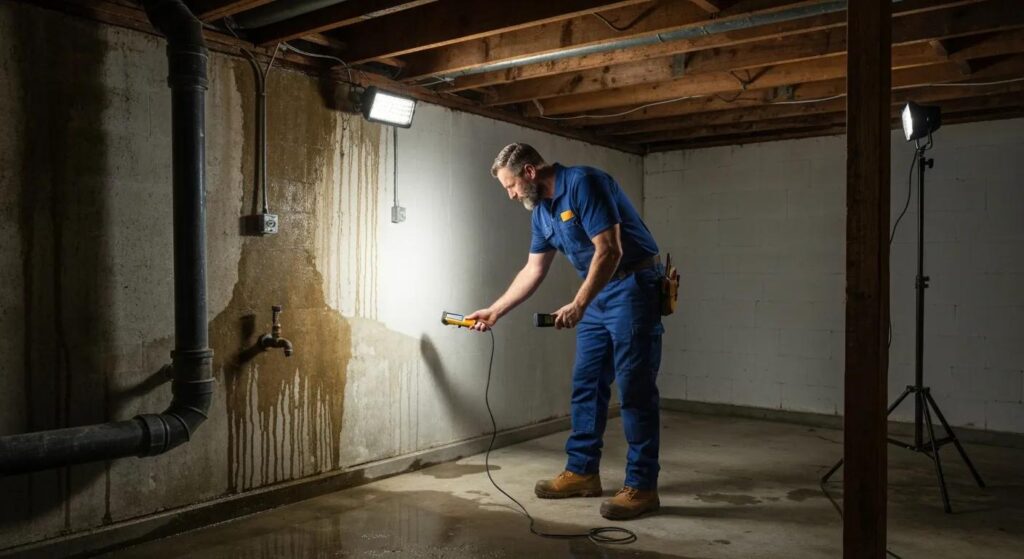
Visible indicators of water intrusion include damp or dark patches on walls, peeling or bubbling paint, white powdery efflorescence, and periodic standing water after storms; these signs often correlate with musty odors or increased indoor humidity that suggest biological growth. Mold may appear as discoloration along baseboards, in drywall corners, or behind stored items, and allergic symptoms among household members often accompany persistent dampness. Differentiating between transient dampness (temporary condensation) and ongoing leaks requires observing patterns—if stains reappear after each heavy rain, the issue is likely structural or drainage-related. Immediate homeowner steps include removing stored items from affected areas, measuring relative humidity, cleaning non-porous surfaces, and scheduling a professional moisture assessment to determine permanent remediation. The following section compares the most effective waterproofing solutions available to address these signs and underlying causes.
Which Basement Waterproofing Solutions Are Most Effective in Cliffside Park NJ?
Basement waterproofing solutions fall into interior measures (interior French drains, sump pump systems, sealants) and exterior measures (membranes, excavation, soil grading), and the right approach depends on access, severity of hydrostatic pressure, and the homeowner’s long-term goals. Interior French drains and sump pumps collect and remove groundwater at the foundation plane without major excavation, which is often preferable for houses with limited exterior access or close lot lines; exterior excavation and membrane systems block water before it reaches the wall but carry higher cost and disruption. Complementary measures like correcting exterior grading, extending downspouts, and installing backflow prevention reduce inflow volume and improve performance of any drainage system. Below are concise comparisons of common solutions and when each is typically recommended, followed by a practical comparison table for quick reference to help homeowners decide. After the technical comparison, the following subsections explain interior French drains and sump pump systems in detail.
Different waterproofing options suit different site conditions and performance goals: basement waterproofing services
- Interior French Drain: Best when exterior excavation is impractical; collects groundwater at footing level and conveys it to a sump.
- Sump Pump System: Best for active removal of collected water; essential where water accumulation is recurrent.
- Exterior Membrane & Excavation: Best for preventing water at the source; effective for severe hydrostatic conditions or repeated seepage.
- Crawl Space Encapsulation: Best for humidity control and energy savings rather than primary basement leak prevention.
This comparison highlights that proper system choice depends on specific site characteristics and homeowner priorities, and the next sections provide focused explanations on interior French drains and sump pump systems including customization opportunities and consultation options.
| System | Problem Addressed | Best-Use Scenario |
|---|---|---|
| Interior French drain | Collects groundwater entering under floor or through walls | Homes with limited exterior access or localized seepage |
| Sump pump + battery backup | Removes collected water from sump pit to discharge point | Flood-prone basements and homes needing active drainage |
| Exterior membrane/excavation | Stops water at the wall and diverts surface runoff | Severe hydrostatic pressure or repeated perimeter seepage |
| Crawl space encapsulation | Controls moisture and improves HVAC efficiency | Homes with crawl spaces affecting indoor humidity and energy use |
How Does Interior French Drain Installation Prevent Water Damage?
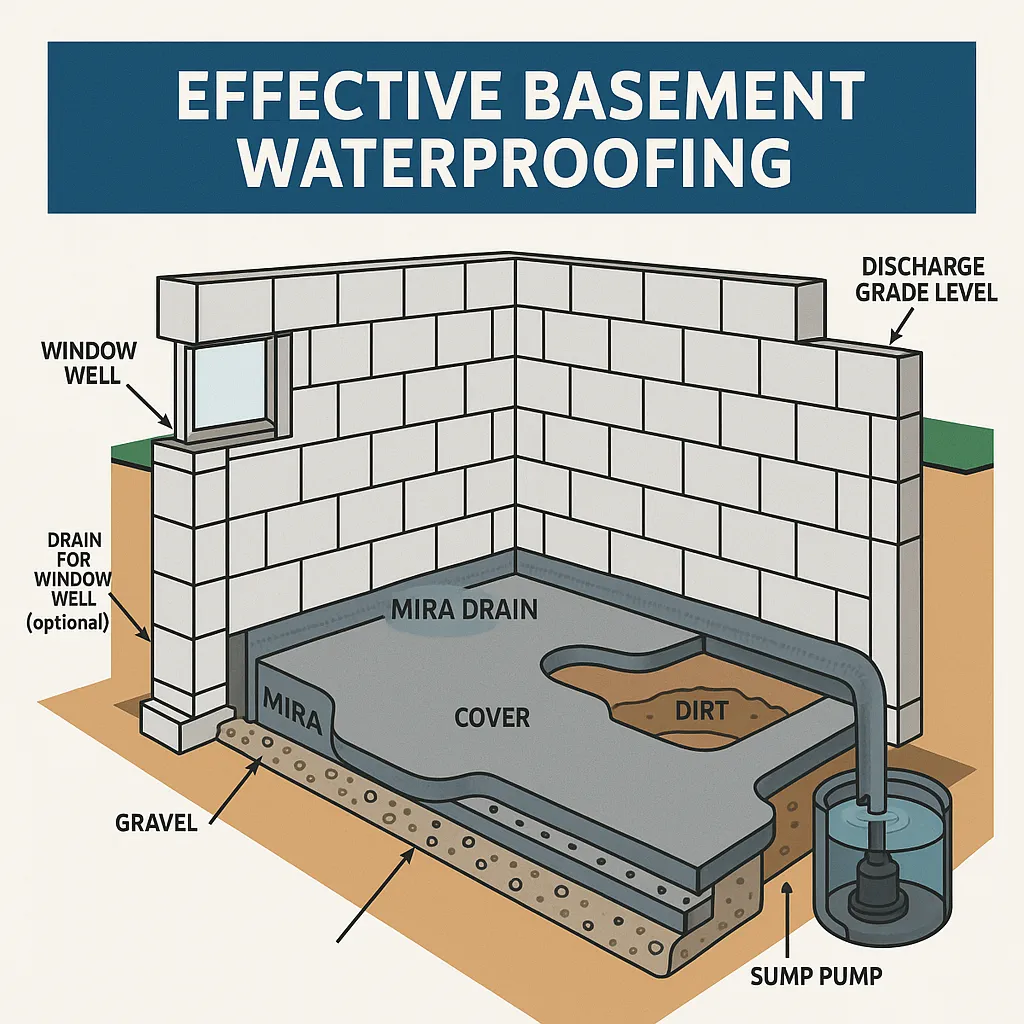
An interior French drain is a subsurface perimeter system placed at the footing level that captures groundwater and channels it into a central sump pit, thereby preventing water from rising into the basement floor and walls. The mechanism relies on creating a lower-resistance pathway—the drain tile and gravel trench—so groundwater follows the new channel rather than passing through foundation materials, which reduces hydrostatic pressure on the wall. Typical installation uses a saw-cut or sub-floor trench, perforated pipe, drainage aggregate, and connection to a sump pit and pump; the lifespan depends on materials and maintenance but generally lasts decades if kept clear and paired with a reliable pump. The interior approach avoids exterior excavation in many Cliffside Park lots where houses sit close together, and it integrates well with dehumidification and finished basement systems. Understanding how these components work together naturally leads to the importance of reliable sump pump selection and backup power.
What Are the Benefits of Sump Pump Installation and Battery Backup Systems?
Sump pumps actively remove water collected by an interior drainage system and are the final defense against basement flooding, making them essential where groundwater accumulates or stormwater overwhelms passive drainage. Submersible and pedestal pumps offer different performance and service profiles; the critical decision is selecting capacity and float-switch reliability appropriate to local water volumes, and adding a battery backup ensures continued operation during storms when power outages are most likely. Routine maintenance—testing operation monthly, checking float operation, and verifying discharge piping—keeps pumps dependable, and expected service life varies but is commonly measured in years of heavy-duty use. In flood-prone Cliffside Park homes, pairing a properly sized pump with a battery or secondary pump provides redundancy that prevents catastrophic water damage. The next H2 turns to foundation repair and crawl space strategies that complement drainage systems to protect structure and indoor environment.
How Can Foundation Repair and Crawl Space Encapsulation Protect Your Home?
Foundation repair and crawl space encapsulation protect structural integrity and indoor air quality by addressing damage caused by water intrusion and by controlling subsurface moisture that otherwise transfers to living spaces. Repair methods—such as crack injection, carbon fiber reinforcement, and wall anchors—restore or stabilize weakened foundations by either sealing non-structural leaks or mechanically restraining movement; selecting the right method depends on whether cracks are active, whether walls are bowed, and whether soil movement is ongoing. Crawl space encapsulation uses a vapor barrier, sealed penetrations, insulation, and sometimes a dehumidifier to create a dry, conditioned plane that reduces HVAC loads, lowers relative humidity, and limits mold growth that can affect indoor air. The following table compares common foundation repair methods so homeowners understand expected inspection and warranty norms, and the H3s beneath this section detail specific repair approaches and encapsulation benefits.
| Repair Method | Structural Issue Addressed | Typical Inspection/Repair Time |
|---|---|---|
| Crack injection (urethane/epoxy) | Water-tight sealing of non-moving cracks | Inspection hours; repair often completed in 1 day |
| Carbon fiber straps | Lateral wall support for bowed walls | Inspection to install; installation over 1–2 days |
| Wall anchors / tiebacks | Stabilize large lateral movement due to soil pressure | Engineering review; multi-day installation |
| Underpinning | Address significant settlement or deep foundation failure | Structural engineering required; multi-week work |
What Foundation Crack Repair Methods Restore Structural Integrity?
Crack repair methods range from injection sealing—which fills and seals non-moving cracks using urethane or epoxy—to structural solutions like carbon fiber straps and wall anchors that provide mechanical support for bowed or shifting walls. Injection works well when cracks are primarily leaking rather than moving, restoring water tightness and preventing further interior damage, whereas carbon fiber and anchors address lateral displacement by resisting soil pressure and restoring alignment. For severe settlement or subsidence, underpinning or helical piers transfer loads to deeper, stable soils and typically require a structural engineer’s evaluation and longer repair timelines; these methods also usually carry longer warranty and monitoring expectations. Homeowners should schedule an assessment to determine whether visible cracks are cosmetic or symptomatic of structural movement, and that assessment informs the decision between sealant-level repairs and more invasive stabilization. With foundation integrity restored, controlling moisture at the crawl space and basement levels becomes far more effective—next we examine encapsulation benefits.
How Does Crawl Space Waterproofing Improve Humidity Control and Energy Efficiency?
Crawl space encapsulation reduces moisture entry by sealing vents, installing a continuous vapor barrier over the floor and walls, and adding insulation and a dehumidifier when needed to maintain relative humidity in a controlled range. This environment prevents soil moisture from evaporating into the HVAC return air, which often reduces system cycling and improves energy efficiency in heated and cooled spaces; homeowners commonly see measurable reductions in HVAC load and fewer humidity-related repairs after encapsulation. Encapsulation also lowers mold risk and allergen transfer into living areas, improving indoor air quality and occupant health, especially in humid coastal-adjacent climates like Cliffside Park. Routine maintenance typically includes periodic inspection of the vapor barrier, servicing the dehumidifier, and ensuring drainage paths remain clear; knowing these benefits helps homeowners balance upfront costs against ongoing energy and health gains. The following H2 reviews typical costs and the long-term value homeowners can expect from various waterproofing interventions.
What Are the Costs and Long-Term Benefits of Basement Waterproofing in Cliffside Park NJ?
Typical costs for basement waterproofing vary by solution: interior French drain plus sump installation is often more affordable than full exterior excavation, while foundation stabilization and underpinning represent the higher end due to structural scope and engineering. Key cost drivers include site accessibility, soil conditions, extent of visible damage, whether foundation repair is required, and whether battery backup and dehumidification are included; permit requirements and seasonal demand can also affect local labor rates. Long-term benefits include protected property value, reduced mold remediation risk, lower insurance claims, and potential energy savings when encapsulation reduces HVAC load, so investments often justify themselves over time through avoided repair and health costs. Below is a cost-driver table showing typical local ranges and major factors that change price, followed by warranty expectations and a short business-focused note encouraging homeowners to request a free, no-obligation consultation for an accurate on-site estimate.
Common factors that increase or decrease waterproofing costs:
- Extent of water intrusion: Larger or structural leaks raise costs significantly.
- Access and excavation needs: Exterior excavation increases labor and material expenses.
- Foundation repairs required: Structural stabilization is a major cost driver.
| Service | Typical Local Cost Range | Key Factors That Change Price |
|---|---|---|
| Interior French drain + sump | $3,000 – $10,000 | Basement finish, access, pump capacity, battery backup |
| Exterior excavation & membrane | $8,000 – $25,000+ | Soil removal volume, landscaping restoration, permit costs |
| Foundation crack repair | $500 – $8,000 | Crack nature (active vs inactive), number of walls, engineering |
| Crawl space encapsulation | $2,000 – $8,000 | Area size, insulation needs, dehumidifier inclusion |
How Much Does Basement Leak Repair and Waterproofing Typically Cost?
Ballpark ranges help homeowners set expectations: a basic interior drainage and sump system typically falls in the lower-to-mid range, exterior excavation with membrane and grading is a higher investment, and foundation stabilization or underpinning can be the most expensive depending on scope. Costs increase when access is limited, when multiple walls require treatment, or when active structural repair is necessary; conversely, homes with easy access and only minor seepage often see lower pricing. Homeowners should consider lifecycle costs—pumps, batteries, and dehumidifiers require service and replacement—and weigh these against the long-term savings from avoided mold remediation and structural damage. To get an accurate number for your property, request a free on-site estimate so a professional can inspect soil, foundation type, and water sources to produce a tailored quote. The next subsection outlines typical warranty and guarantee expectations you should seek when comparing proposals.
What Warranties and Guarantees Should You Expect from Local Waterproofing Services?
Expect to see separate warranty types for mechanical components (like sump pumps and battery backups), material products (membranes, drain tiles), and workmanship; product warranties often cover manufacturer defects while workmanship guarantees cover installation quality for a defined period. Typical workmanship guarantees vary by provider but should be provided in writing and should clearly state what is covered, the duration, and any maintenance responsibilities required to keep warranties valid. Red flags include vague verbal promises without written documentation, lack of clarity on who services pumps or batteries, and proposals that omit a clear scope of post-install support; you should also ask about response time for service calls and any transferable coverage if you sell the home. Carefully reviewing and comparing warranty language helps protect your investment and ensures that long-term benefits materialize as expected. The next H2 explains why choosing local experts familiar with Cliffside Park conditions improves outcomes and supports warranty claims and follow-up service.
Why Choose Local Basement Waterproofing Experts in Cliffside Park NJ?
Local experts understand Cliffside Park’s unique topography, lot constraints, and common construction types, which allows them to recommend tailored solutions that address both visible water entry and the underlying hydrology driving it. Site-specific knowledge—such as typical soil composition, slope, and common drainage patterns—means a local assessment can more accurately predict hydrostatic behavior and design effective interior or exterior systems accordingly. In addition to technical fit, local providers are often better positioned to coordinate necessary permits, adapt plans to neighborhood access limitations, and provide timely follow-up service under workmanship guarantees. A thorough free consultation typically includes a visual inspection, moisture measurements, interior and exterior grading assessment, and a written comparison of recommended systems so homeowners can weigh options with transparent cost drivers. The following subsections outline common Cliffside Park challenges and explain what a free consultation will inspect and why testimonials and references matter in evaluating proposals.
What Unique Challenges Do Cliffside Park Basements Face?
Cliffside Park properties frequently sit on modest slopes and tight lots where exterior excavation is constrained by neighboring structures and streets, making interior drainage solutions and careful grading adjustments more practical in many cases. Local soil types and historically variable storm patterns can elevate the groundwater table seasonally, increasing hydrostatic pressure against older foundation systems and creating recurrent seepage in susceptible basements. Many homes were built with foundation types that perform differently when exposed to lateral soil moisture, so recognizing these patterns helps match repair and waterproofing methods to the home’s construction. Understanding these site-specific constraints leads to more accurate cost estimates and system selection, especially when choosing between less-disruptive interior systems and more invasive exterior membranes.
How Do Free Consultations and Customer Testimonials Support Your Decision?
A free consultation typically covers a checklist of visible indicators and diagnostic steps: exterior grading and downspout routing, interior moisture readings, baseline photos, an evaluation of sump pit capacity and pump condition, and a clear written estimate outlining recommended options and warranties. Testimonials and case studies provide additional context by showing how similar local conditions were handled and what results homeowners experienced, but you should interpret them as one data point alongside written references and documented warranty terms. Asking for before-and-after photos, documented timelines, and references for projects in similar Cliffside Park settings helps verify a contractor’s ability to deliver and to service systems post-installation. After a free consultation, homeowners should compare proposals on technical merit, warranty coverage, and clarity of cost drivers before selecting a path forward. The next H2 answers common homeowner questions to help you evaluate contractors and maintain systems once installed.
How Do You Identify the Best Basement Waterproofing Company Near You?
To evaluate contractors, use a simple checklist: verify proof of insurance and licenses where applicable, request written estimates that itemize scope and costs, and confirm clear workmanship and product warranties in writing. Ask for references and examples of recent jobs in similar lot conditions, and look for transparency about whether a proposed solution is an interior or exterior approach and why it is recommended for your property. Red flags include vague scope descriptions, pressure to sign immediately, and lack of clarity on post-install service and warranty response times. Comparing multiple written proposals focused on technical details and warranties helps you identify the provider best suited to your home’s needs.
What Maintenance Is Required After Waterproofing Installation?
Routine maintenance keeps systems functioning: test sump pumps monthly by pouring water into the pit, clean gutters and downspouts seasonally, inspect visible drain outlets and discharge piping, and service dehumidifiers or backup batteries per manufacturer guidelines. Annual professional inspections of interior drains and pumps are recommended to confirm float-switch operation, verify pump amperage draw, and clear any debris that could reduce capacity, and keep records of service to protect workmanship warranties. Recognizing warning signs—unusual pump cycling, rising indoor humidity, or new wall staining—should prompt a prompt service call to prevent escalation. If you prefer a professional assessment or follow-up service, you can request a free consultation or on-site service visit to get a written maintenance plan and estimate tailored to your system.
For homeowners ready to move from research to action: request a free consultation or on-site service to receive a customized inspection, a written comparison of interior and exterior waterproofing options, and a transparent estimate that outlines costs, expected timelines, and warranty terms. This service helps convert the diagnostic information in this guide into a specific plan for protecting your Cliffside Park home against water intrusion, structural damage, and moisture-related health risks.

4kmyb9