NJ Basement Waterproofing: Costs, Services & Proven Solutions
Basement waterproofing is essential for protecting your home’s living space, structural integrity, and indoor air quality by stopping water intrusion and controlling subsurface moisture. This comprehensive guide explains why New Jersey homeowners face unique basement moisture risks, how to recognize the early signs of a wet basement, what interior and exterior waterproofing options are available, and how these choices impact cost and your home’s long-term value. You’ll learn practical diagnostic checks, typical cost ranges for common methods, technical overviews of interior systems like French drains and sump pumps, exterior strategies for keeping water away from foundations, and crucial moisture-control measures that reduce mold and radon risks. We also outline foundation repair techniques for structural problems and clarify when to call a professional. Throughout, we emphasize localized factors—NJ soils, freeze/thaw cycles, and heavy rainfall patterns—that influence method selection and expected outcomes, helping you choose the right solution for your property.
Common Signs of Basement Water Damage in New Jersey
Basement water damage often starts with subtle indicators that point to moisture pathways, structural stress, or environmental conditions. Recognizing these signs early is crucial to prevent escalation to mold growth, foundation deterioration, and the loss of usable space. In New Jersey, seasonal heavy rains and variable soils make vigilance especially important; homeowners should inspect their basements after storms and during spring thaw to catch problems before they worsen. The following signs are common and diagnostic: they reveal both health and structural risks and help determine whether immediate action or careful monitoring is appropriate.
Look for these observable signs of basement water damage:
- Musty, persistent odors that linger even after airing out a room, indicating high humidity and potential mold growth.
- White, powdery deposits (efflorescence) on walls, signaling moisture moving through masonry and leaving salts behind.
- Staining, peeling paint, or blistering drywall, which show repeated dampness and possible seepage through walls or the floor.
- Standing water, wet spots, or puddles after rain, indicating active infiltration or inadequate drainage.
- Visible mold colonies or discoloration on surfaces, pointing to prolonged moisture and biological growth.
These diagnostic clues will guide your next steps for investigation and repair. If you observe multiple signs, we recommend a professional inspection to identify underlying causes and determine the most effective solutions.
How to Recognize Musty Smells and Mold Growth in Your Basement
A musty smell typically arises when organic materials remain damp long enough for microbial growth, and mold colonies can form in as little as 24–48 hours under the right conditions. Visually, mold appears as spots or fuzzy growth in shades of black, green, or brown on porous materials such as wood, paper, or drywall; it often comes with a stale, earthy odor. Health impacts include aggravated allergies and respiratory irritation, so detecting mold early reduces exposure and the scope of remediation needed. If you spot mold or persistent mustiness, document the location and extent, dry the area, and plan for moisture-source correction, followed by professional remediation if the affected area is extensive.
Recognizing mold naturally leads to checking wall surfaces and masonry for other moisture indicators such as efflorescence and cracks, which can reveal the pathways for the water supporting microbial growth.
What Does Efflorescence on Basement Walls Indicate?
Efflorescence is a crystalline white deposit left behind when water migrates through concrete or brick, dissolves salts, and evaporates at the surface. Its presence is a reliable moisture indicator: water is actively moving through your wall or slab and bringing soluble minerals with it. While efflorescence itself is not mold, it signals conditions that support biological growth and long-term material degradation. Homeowners should treat efflorescence as a symptom that requires finding the source—whether it’s surface condensation, seepage through cracks, or hydrostatic pressure—before cosmetic cleaning to prevent recurrence.
Identifying efflorescence helps us focus diagnostic efforts on moisture pathways, which in turn determines whether interior drainage, exterior excavation, or targeted repair is the appropriate next step.
How to Detect Basement Wall Cracks and Water Leaks
Basement cracks range from hairline shrinkage to significant structural movement; distinguishing them starts with a close visual inspection and monitoring over time. Hairline cracks often reflect concrete curing and are less likely to leak, whereas wider, horizontal, or stair-step cracks often signal differential settlement or lateral pressure and can allow active leaks. Tests such as applying tape to check for active seepage, using a moisture meter, or marking and measuring crack width month-to-month help assess urgency. Active water flow, widening cracks, or misaligned masonry warrant professional evaluation because they can indicate structural issues requiring coordinated waterproofing and foundation repair.
Understanding the type and activity of cracks helps us determine whether interior sealing, injection repair, or structural reinforcement should be combined with waterproofing measures to stop leaks and prevent recurrence.
Why Do Wet Basement Floors and Puddles Occur After Rain?
Wet basement floors and post-rain puddles typically stem from exterior water accumulation, poor grading, clogged gutters, or hydrostatic pressure that forces groundwater through joints and pores. In New Jersey, heavy downpours and seasonal saturation increase subgrade water tables, making poor site drainage a frequent contributor. Short-term measures include redirecting downspouts, improving surface grading, and sealing obvious entry points; long-term solutions range from interior French drains with sump pumps to exterior excavation and membrane systems that reduce hydrostatic pressure. Addressing the source of water movement is critical to preventing recurring puddles and the downstream effects of moisture on finishes and indoor air quality.
Correctly diagnosing whether the issue is surface runoff, gutter failure, or subsurface pressure determines whether interior drainage or exterior remediation will be most effective for your home.
Effective Basement Solutions offers free inspections to accurately diagnose these signs and recommend appropriate next steps. A no-cost inspection helps homeowners convert observed symptoms into a prioritized, documented repair plan without any pressure to commit.
Basement Waterproofing Cost in NJ: What to Expect
Basement waterproofing costs in New Jersey vary widely based on the chosen method, severity of problems, and site access. Typical projects range from modest interior solutions to comprehensive exterior excavations. Factors that influence price include basement size, depth of excavation needed, the chosen interior vs. exterior approach, pump and backup requirements, and any additional foundation repair work. To support your decision-making, the table below compares common methods with typical cost ranges and when each is recommended, helping you match your budget, disruption tolerance, and longevity expectations.
| Method | Average Cost Range (NJ) | When Recommended / Pros & Cons |
|---|---|---|
| Interior French drain + sump pump | $3,000 – $8,000 | Recommended for existing finished basements or when exterior access is limited; less disruptive, highly effective at managing hydrostatic seepage. |
| Exterior foundation waterproofing | $8,000 – $25,000+ | Best for recurring exterior-driven leaks or severe hydrostatic pressure; more durable but more disruptive and costly due to excavation. |
| Sump pump installation (standalone) | $800 – $3,000 | Appropriate when water collects in low spots; cost depends on pump capacity and need for basin or piping upgrades. |
| Foundation crack repair (injection/stitching) | $500 – $3,500 | Used for targeted leaks and structural stabilization; often paired with drainage fixes for lasting results. |
This cost comparison clarifies the tradeoffs between disruption, durability, and price. Interior methods usually cost less and are faster to install, while exterior solutions often deliver longer-term reduction of hydrostatic forces.
What Factors Affect Basement Waterproofing Cost in New Jersey?
Several site-specific and project variables determine the final pricing for your waterproofing project. The severity of leakage, the method chosen, and the extent of structural repair work needed are primary drivers. Labor intensity rises with excavation depth and difficulty of access; older homes with finished basements often require additional finish repairs after interior work. Material choices—membranes, drainage pipes, sump pump quality, and battery backup systems—change both upfront cost and lifecycle performance. Permitting, localized soil conditions (clay vs. sandy soils), and required grading or downspout rerouting also add to the project scope.
Estimating scenarios help illustrate ranges: a small interior French drain plus a basic sump pump is typically a lower-cost option, while exterior membrane systems with grading correction represent a higher tier. Effective Basement Solutions provides free estimates and a clear breakdown methodology during inspections, explaining precisely how site factors and chosen systems influence cost and long-term value.
How Do Interior and Exterior Waterproofing Costs Compare?
| Approach | Cost Range | Disruption | Longevity / Benefit |
|---|---|---|---|
| Interior systems | Moderate ($3k–$8k) | Low to moderate | Effective for many leaks; less invasive; may require periodic maintenance |
| Exterior systems | Higher ($8k–$25k+) | High | Reduces hydrostatic pressure; longer service life when properly installed |
| Hybrid (both) | Combined cost | High | Best for chronic or severe cases; maximizes protection |
Choosing between interior and exterior depends on the leak source, your budget, and the desired lifespan of the fix. A professional inspection will clarify which approach is most appropriate for your home.
What Is the Average Cost of Sump Pump Installation in NJ?

Sump pump installation costs vary with pump type, basin preparation, piping, and optional battery backup. Typical installation ranges from roughly $800 for a basic pedestal pump and basin in an accessible location to $3,000 or more for a high-capacity submersible pump, larger basin excavation, and professional discharge routing with a battery backup system. Key cost factors include pump horsepower, basin size, labor for trenching or slab cutting, and whether a battery backup is added for storm resilience.
Including a battery backup significantly increases reliability during power outages and storms and is highly recommended for homes in flood-prone areas. The added cost is often justified by reduced flood risk and invaluable peace of mind.
How Can Basement Waterproofing Increase Your NJ Home’s Value?
Waterproofing converts unusable damp areas into stable, potentially habitable space and reduces disclosure issues during resale, often translating into improved buyer confidence. A dry basement supports finished living areas, increases functional square footage, and may improve perceived structural maintenance, all of which significantly influence marketability. While exact ROI varies by region and property, investing in comprehensive waterproofing and transferable warranties typically offers stronger resale narratives and fewer post-sale surprises for buyers.
Assessing value includes quantifying added usable square footage, reduced remediation liability, and the benefit of transferable warranties in purchase negotiations, which together can make waterproofing a truly worthwhile investment.
Interior Basement Waterproofing Solutions Available in New Jersey
Interior waterproofing focuses on collecting water that enters the basement and efficiently moving it to a discharge point. This approach offers effective, less disruptive solutions for many New Jersey homes. Our common systems capture seepage at the footing or slab level and route it to a sump pump, control moisture, and integrate with dehumidification and encapsulation measures for healthy indoor air. The table below lists our core interior solutions, their key components, and typical benefits to help you understand what each system includes.
| Solution | Components | Key Benefits / Typical Lifespan |
|---|---|---|
| Interior French drain | Perforated pipe, gravel, filter fabric, channel to sump | Collects and redirects subsurface water; 15–30 years with proper maintenance |
| Sump pump system | Basin, submersible or pedestal pump, discharge piping | Removes accumulated water; pump life 5–15 years depending on quality |
| Battery backup sump pump | Battery, backup pump or power system | Ensures operation during outages; critical for storm resilience |
| Interior crack repair | Epoxy/injection material, surface sealants | Stops active leaks; lifespan varies with structural conditions |
How Does French Drain Installation Prevent Basement Water Intrusion?
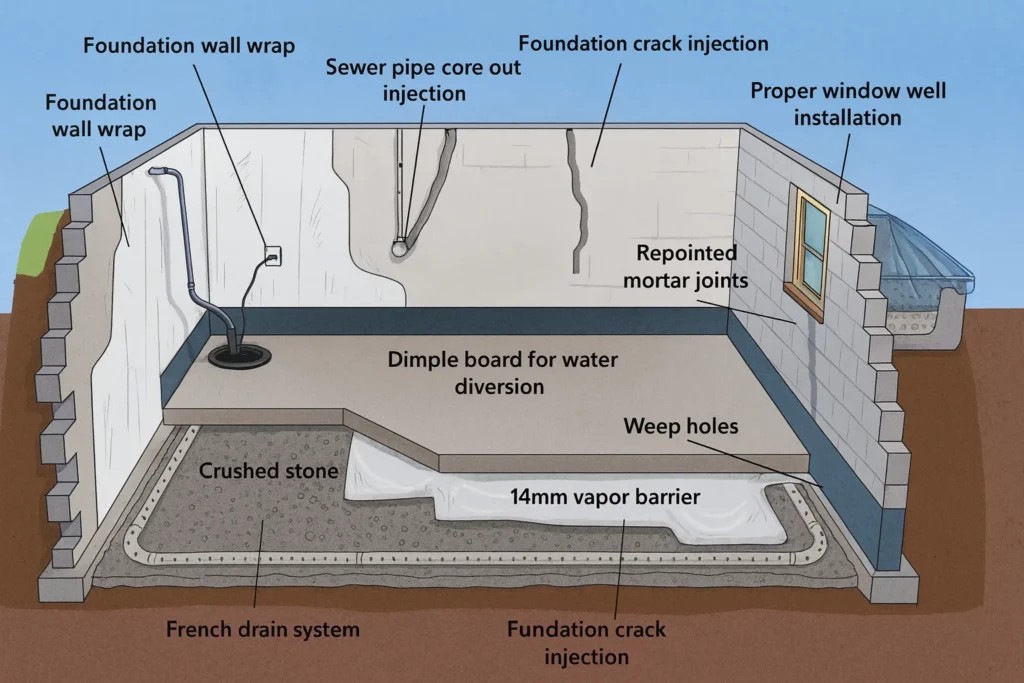
An interior French drain captures water at the base of foundation walls or below slab level using perforated pipe surrounded by gravel and filter fabric, directing collected water into a sump basin. The system effectively reduces hydrostatic pressure against the foundation by intercepting groundwater before it seeps through cracks or pores. When tied to a properly sized sump pump, it provides reliable removal of collected water. Installation typically involves removing a narrow channel at the wall–floor joint or cutting the slab, installing the drainage components, and finishing the area. French drains are especially effective in homes with high groundwater or where exterior access is limited.
Understanding French drain mechanics clarifies why pairing this collection system with a quality sump pump and a maintenance plan ensures long-term performance for wet basements.
Why Choose Sump Pump Systems for NJ Basements?
Sump pump systems actively remove collected groundwater from a basin and discharge it safely away from the foundation, preventing accumulation that leads to seepage and mold. Pumps come in submersible and pedestal designs, each with tradeoffs in noise, lifespan, and installation complexity; selecting the right pump depends on expected flow, head height, and reliability needs. Proper sizing, float switch configuration, and discharge routing to an approved outflow point are essential to prevent backups and ensure consistent operation. Regular testing, cleaning, and consideration of battery backup significantly enhance resilience during storms and power outages.
Selecting the correct pump and installation method reduces flood risk and integrates seamlessly with dehumidification and drainage systems for comprehensive moisture control.
What Are the Advantages of Battery Backup Sump Pumps?
Battery backup sump pumps operate during electrical outages, ensuring continuous water removal when power loss coincides with heavy rain events—precisely when sump functionality is most critical. Backups typically provide hours of run time depending on battery capacity and pump draw; they can prevent catastrophic flooding and costly remediation when primary power is lost. Maintenance involves periodic battery checks and ensuring the backup is properly charged. For New Jersey homeowners in flood-prone zones or areas with frequent storm-related outages, battery backup systems are a prudent and highly recommended addition to standard sump installations.
Including a battery backup system increases installation cost but provides a significant reduction in flood risk and dramatically improves system reliability during emergencies.
How Is Interior Crack Repair Performed to Stop Leaks?
Interior crack repair commonly uses epoxy or polyurethane injection to fill voids and seal pathways while restoring some structural integrity, with surface sealing applied as complementary protection. Preparatory steps include cleaning the crack, assessing for movement, and choosing a material suited to the crack type—epoxy for structural bonding and polyurethane for flexible water sealing. Injection ports are installed and resin injected under controlled pressure to penetrate the void, then ports are removed and the surface is finished. Crack repair is most effective when combined with drainage that relieves hydrostatic pressure, ensuring injected materials are not subject to continuous forcing water that can compromise an isolated repair.
Coordinating crack repair with broader waterproofing measures provides a more durable and lasting outcome than repair alone.
Exterior Basement Waterproofing Services from Effective Basement Solutions in NJ
Exterior waterproofing prevents water from reaching foundation walls by addressing the problem at its source: the exterior soil and water table. Our exterior systems typically include excavation to the footing, application of waterproof membranes or coatings, installation of exterior drainage (perimeter drains), and backfill with proper grading. These methods effectively reduce hydrostatic pressure, limit moisture migration, and can significantly extend the lifespan of your foundation. Exterior solutions are especially appropriate for persistent seepage originating outside the home or when prior interior fixes have not fully resolved water entry.
Exterior work reduces long-term water exposure and often integrates with surface drainage corrections to provide comprehensive, robust protection for New Jersey properties.
How Does Exterior Foundation Waterproofing Protect NJ Homes?
Exterior waterproofing shields foundation walls with durable membranes or coatings that block moisture and combines them with drainage layers to move water safely away from the structure. By stopping water before it reaches masonry, exterior systems effectively lower hydrostatic pressure and reduce the driving force that pushes water through joints and pores. Installation steps include excavating to the footing, applying a compatible membrane or coating, placing drainage board or filter fabric and perforated drainage pipe, and restoring soil with positive grading. For homes with high water tables or chronic exterior saturation, exterior waterproofing is often the most durable long-term solution.
The decision to pursue exterior work depends on the leak source, site constraints, and budget tradeoffs compared with interior systems. Our experts can help you make the best choice.
What Are Exterior Drainage Systems and How Do They Work?
Exterior drainage systems include components such as perimeter drains, proper grading, downspout extensions, and sometimes dry wells to redirect water away from the foundation. Perimeter drains collect groundwater at footing level and convey it to an outlet or to a sump discharge system, while grading and downspout routing reduce surface water pooling near the foundation. Simple homeowner checks—looking for water pooling, soggy areas near the foundation, or gutters that discharge too close to the house—help identify drainage failures. Correcting grading and drainage often accompanies waterproofing to ensure surface water does not overload subsurface defense systems.
Improving exterior drainage reduces the volume of water the foundation must resist, often lowering pressure on interior systems and significantly improving long-term performance.
Why Is Exterior Waterproofing Important for New Jersey’s Climate?
New Jersey’s climate features heavy rain events, coastal and inland water influence, and freeze/thaw cycles that can exacerbate soil movement and water infiltration around foundations. Seasonal saturation raises groundwater tables, making exterior barriers and drainage especially important where soil types hold moisture against foundations. Freeze/thaw cycles can also open joints and cracks if water is allowed to repeatedly saturate and freeze in foundation elements. Exterior waterproofing and improved grading directly address these climate-driven mechanisms, reducing cyclic stress and limiting conditions that lead to recurring leaks and structural wear.
Given NJ’s challenging weather patterns, exterior measures are often prioritized for properties with persistent exterior wetness or where long-term protection and reduced maintenance are desired.
How Foundation Repair Services Prevent Structural Damage in NJ Basements
Foundation repair addresses structural movement and stabilization issues—such as bowing walls, differential settlement, and widening cracks—that can accompany chronic water pressure and soil changes. Our repair methods restore lateral capacity and redistribute loads to reduce ongoing movement, protecting both the foundation and interior finishes. Identifying structural indicators early—tilted floors, sticking doors, or expanding cracks—allows us to select repair options that minimize further damage. Integration of repair with waterproofing ensures that structural stabilization is not undermined by persistent moisture and that both short-term safety and long-term durability are achieved.
What Are Carbon Fiber Wall Straps and How Do They Stabilize Foundations?
Carbon fiber wall straps are high-strength composite strips bonded to masonry walls to restrain movement and reverse small-to-moderate bowing without invasive excavation. They restore lateral capacity by transferring bending stresses into the strap and anchorage system, providing a thin, noninvasive reinforcement that preserves interior space. Installation involves meticulous surface preparation, adhesive bonding of the strap, and properly designed end anchorage to ensure optimal load transfer. Carbon fiber straps are durable and resistant to corrosion, making them a preferred option when wall movement is within the method’s design limits and when homeowners want a less disruptive alternative to heavy structural work.
Used appropriately, carbon fiber straps stabilize walls effectively and can be combined with interior drainage to address both movement and moisture in tandem for a comprehensive solution.
How Does Steel I-Beam Bracing Support Bowing Basement Walls?
Steel I-beam bracing provides rigid support for severely bowed or displaced walls by creating a structural member that resists inward soil pressure and transfers loads to the floor or foundation base. Installation typically requires engineered placement, anchoring to stable points, and careful adjustment to straighten or restrain the wall without inducing unintended stresses. I-beam systems are selected when loads exceed noninvasive solutions like carbon fiber straps and when long-term mechanical support is necessary. They are robust and highly effective in severe cases but involve more invasive installation and require coordination with waterproofing to prevent corrosion and ensure overall longevity.
When movement indicates structural compromise, a professional evaluation determines whether I-beam bracing or alternative reinforcement best matches the condition and your performance goals.
When Is Foundation Crack Repair Necessary for NJ Homes?
Foundation crack repair is warranted when cracks show active water flow, widening trends, misalignment, or when they coincide with other structural signs such as sticking doors or sloping floors. Immediate repair reduces water entry and limits further structural deterioration; the chosen technique—epoxy injection, polyurethane sealing, or stitch repairs—depends on whether the need is primarily structural bonding or flexible water sealing. Interim measures include monitoring with marks or gauges and reducing hydrostatic loads via drainage; permanent fixes pair targeted crack repair with overall waterproofing to prevent recurrence.
Timely intervention prevents small issues from escalating into costly structural failures that require broader remediation.
How Basement Moisture Control Improves Home Health in New Jersey
Effective moisture control enhances indoor air quality, significantly reduces mold growth, and preserves structural materials; all of these contribute to healthier living environments and lower long-term maintenance costs. Encapsulation, dehumidification, and professional mold remediation limit biological growth by removing the moisture that sustains it, while radon mitigation addresses a separate airborne health risk that can be influenced by basement ventilation and sealing. Our effective moisture control systems are designed with target humidity levels and integrated approaches—combining vapor barriers, controlled drainage, and continuous dehumidification—to create stable indoor conditions. The table below links specific measures to health and property benefits with example outcomes.
| Measure | Health / Property Benefit | Estimated Impact / Example Outcome |
|---|---|---|
| Crawl space encapsulation | Reduces moisture migration and mold risk | Lowers relative humidity and prevents odor; energy savings via reduced HVAC load |
| Dehumidification systems | Maintains target humidity (30–50%) | Limits mold growth and improves comfort; reduces musty odors |
| Mold remediation | Removes active contamination | Improves indoor air quality and reduces health symptoms; paired with waterproofing prevents recurrence |
| Radon mitigation | Reduces radon levels in living spaces | Lowers long-term lung cancer risk by venting and sealing common entry points |
What Is Crawl Space Encapsulation and How Does It Prevent Mold?
Crawl space encapsulation creates a sealed barrier using vapor barriers on floors and walls, drainage management, and often insulation to limit ground moisture entry into the home. By effectively stopping soil vapor and water migration, encapsulation significantly reduces humidity levels and eliminates conditions favorable to mold and rot. Proper installation includes sealing vents, installing a continuous liner, and addressing drainage to prevent standing water. Regular inspection and adding a dehumidifier where necessary maintain the system’s effectiveness and support improved air quality for the living spaces above.
Encapsulation often pairs with dehumidification and ventilation strategies to sustain dry conditions and prevent recurrent mold issues, ensuring a healthier home environment.
How Do Dehumidification Systems Reduce Basement Humidity?
Dehumidifiers actively remove moisture from basement air to maintain target relative humidity—commonly between 30% and 50%—which effectively inhibits mold growth and reduces condensation on cold surfaces. Selecting the correct system involves sizing for basement volume, expected moisture load, and whether continuous drainage is available for condensate removal. Placement near the moisture source and periodic maintenance, such as filter cleaning and coil checks, keep performance optimal. Continuous dehumidification also protects stored materials, reduces musty odors, and supports the longevity of finishes and mechanical equipment.
Maintaining appropriate humidity levels perfectly complements drainage and waterproofing to create a truly dry, healthy basement environment.
What Are the Benefits of Mold Remediation for NJ Basements?
Professional mold remediation removes active contamination, contains spores to prevent spread, and applies cleaning and removal techniques tailored to material types and contamination extent. The process significantly improves indoor air quality, reduces allergen and irritant loads, and restores affected areas to safe conditions for occupancy. Importantly, remediation should always follow the correction of moisture sources; otherwise, mold often returns. Combining remediation with waterproofing and dehumidification results in a lasting reduction of health risks and improved property condition.
Remediation paired with moisture control is a comprehensive approach that addresses both the symptom and the underlying cause of biological contamination.
How Does Radon Mitigation Protect NJ Homeowners?
Radon mitigation reduces the concentration of radon gas—a naturally occurring radioactive gas that can accumulate in basements—by sealing common entry points and installing venting systems that draw gas from below the slab or foundation and discharge it safely above the roofline. Testing identifies whether mitigation is necessary; methods include sub-slab depressurization and sealing combined with targeted ventilation. Testing after waterproofing or remodeling is recommended because changes in sealing and airflow can alter radon entry dynamics. Effective mitigation lowers long-term exposure and is an important complement to moisture control for overall indoor environmental quality.
Radon reduction measures should be coordinated with other basement work to ensure both air quality and structural concerns are comprehensively addressed.
Why Effective Basement Solutions is Your Trusted Basement Waterproofing Company in New Jersey
Effective Basement Solutions proudly positions itself as a leading provider of proven waterproofing and foundation services for New Jersey homeowners, backed by key trust signals. We emphasize our dedicated in-house crews (never subcontractors), offer a robust 30-year transferable warranty, and provide a 12-month mold-free certificate for qualifying work—features that signal long-term accountability and post-service protection. Our free inspections and estimates help homeowners understand their problems without upfront cost, and our license number 13vh06363800 is provided as a testament to our operational credentials. These elements together aim to reduce uncertainty and empower homeowner decision-making when addressing critical basement moisture and structural issues.
Below are concise reasons why homeowners consistently choose a focused local provider like us and what to expect when engaging for an inspection and estimate.
Why Over 20 Years of Experience Matters for NJ Basement Waterproofing
Experience brings invaluable pattern recognition across diverse soil types, construction methods, and climate impacts, enabling more accurate diagnosis and tailored solutions that reduce callbacks and unnecessary work. With our long experience comes familiarity with complex scenarios—such as homes with limited exterior access or mixed foundation types—and the ability to sequence repairs and waterproofing for the best outcomes. Experienced teams also streamline permitting and site logistics, translating into clearer project timelines. This deep expertise supports better long-term results for homeowners confronting NJ-specific moisture challenges.
That depth of experience informs both our technical choices and the clear, honest communication homeowners receive during assessment and repair planning.
How In-House Crews Ensure Quality Without Subcontractors
Our in-house crews provide consistent, high-quality workmanship because Effective Basement Solutions directly controls training, scheduling, and quality standards rather than relying on variable subcontractor practices. This model significantly improves accountability—issues are addressed by the same dedicated team that performed the work—and fosters continuity from inspection through warranty service. In-house teams can also coordinate more smoothly across disciplines, such as combining foundation repair with waterproofing, reducing miscommunication. Homeowners consistently find clearer lines of responsibility and predictable standards when crews are employed directly by our company.
This consistency in labor and management helps preserve warranty integrity and ensures all work meets our published standards for excellence.
What Are the Benefits of a 30-Year Transferable Warranty and Mold-Free Certificate?
A long transferable warranty provides both buyers and sellers assurance that waterproofing work is covered beyond the original owner, often significantly improving marketability and reducing post-sale negotiation over past moisture issues. The 12-month mold-free certificate documents immediate remediation outcomes and reinforces that the work included comprehensive measures to control biological growth. Together, these offerings provide invaluable peace of mind and tangible assurances that our installation and remediation efforts are intended to deliver lasting protection. Transferability further enhances resale appeal by attaching verifiable coverage directly to the property rather than just the owner.
Such warranty and certification elements make the investment in waterproofing more defensible and can be a significant factor in purchase decisions.
How to Request a Free Basement Inspection and Estimate in NJ
When you request a free inspection, you can expect a thorough process that begins with a visual survey of interior symptoms, a detailed review of exterior drainage and grading, and targeted assessments such as moisture mapping or crack evaluation. Our inspector documents all findings, explains likely causes in plain language, and outlines recommended options with a clear cost breakdown and timeline for work. A transparent estimate includes method comparison (interior vs. exterior), recommended priority actions, and comprehensive information about warranty coverage and certificates issued upon completion. Scheduling a no-cost inspection provides you with a documented plan that helps you weigh options without any obligation.
Effective Basement Solutions invites New Jersey homeowners to request a free inspection and estimate today to convert observed signs of moisture into an actionable repair plan, fully supported by our in-house crews and robust warranty protection.
Frequently Asked Questions About Basement Waterproofing
What are the long-term benefits of basement waterproofing for homeowners in New Jersey?
The long-term benefits of basement waterproofing are substantial, including enhanced property value, significantly improved indoor air quality, and a reduced risk of mold growth. By preventing water intrusion, homeowners can transform damp basements into usable, healthy living spaces, effectively increasing functional square footage. Additionally, effective waterproofing minimizes the likelihood of costly structural damage, leading to lower maintenance expenses over time. Homeowners also gain invaluable peace of mind, knowing their investment is protected against moisture-related issues, which is particularly important when selling the property in the future.
How often should homeowners inspect their basements for water damage?
We recommend homeowners inspect their basements at least twice a year, ideally in the spring and fall, to catch any signs of water damage early. Furthermore, it’s wise to conduct inspections after heavy rainfall or significant snowmelt, as these events can exacerbate existing moisture issues. Regular checks for musty odors, efflorescence, and visible mold can help identify problems before they escalate. Keeping a close eye on the condition of gutters, downspouts, and grading around the foundation is also crucial for preventing water accumulation near your basement.
What should homeowners do if they find mold in their basement?
If you discover mold in your basement, your first step should be to address the moisture source immediately to prevent further growth. Next, document the extent of the mold and assess whether it’s a small, manageable area that can be cleaned with appropriate protective gear, or if professional remediation is necessary. For larger infestations, hiring a certified mold remediation specialist is highly recommended to ensure safe and effective removal. Following remediation, implementing robust moisture control measures, such as dehumidification and waterproofing, is essential to prevent recurrence.
Are there any DIY methods for basement waterproofing?
While professional solutions often provide the most comprehensive and lasting results, some DIY methods can help mitigate minor moisture issues. Homeowners can start by sealing small cracks in walls and floors with hydraulic cement or epoxy sealants. Installing a dehumidifier can also effectively help control humidity levels. Additionally, ensuring proper grading around the foundation and cleaning gutters to prevent overflow can reduce water accumulation. However, for significant or persistent water intrusion problems, consulting a professional is always advisable to ensure a comprehensive and lasting solution.
What is the role of drainage systems in basement waterproofing?
Drainage systems play a crucial role in basement waterproofing by actively directing water away from the foundation and preventing it from entering the basement. Interior drainage systems, such as French drains, collect water that seeps in and channel it efficiently to a sump pump for removal. Exterior drainage systems, including perimeter drains and proper grading, help manage surface water and significantly reduce hydrostatic pressure against the foundation. Effective drainage minimizes the risk of water damage and is often paired with waterproofing measures for comprehensive, long-term protection.
How can homeowners choose the right waterproofing method for their basement?
Choosing the right waterproofing method involves carefully assessing your specific moisture issues, the basement’s current condition, and your budget. Factors to consider include the precise source of water intrusion (interior vs. exterior), the severity of the problem, and whether your basement is finished or unfinished. Homeowners should also evaluate the long-term effectiveness and maintenance requirements of each method. Consulting with a professional waterproofing contractor, like Effective Basement Solutions, can provide invaluable insights and help tailor a solution that perfectly meets the unique needs of your property.
Ready for a Dry, Healthy Basement?
Basement waterproofing is essential for protecting your home’s structural integrity and enhancing indoor air quality by preventing moisture intrusion. By understanding the specific risks and proven solutions available, New Jersey homeowners can make informed decisions that not only safeguard their property but also significantly increase its long-term value. Take the first crucial step towards a dry, healthy, and safe basement by requesting a free inspection and estimate today. Trust Effective Basement Solutions to provide expert guidance and reliable service tailored precisely to your needs.
