
Basement Waterproofing & French Drains in Union, NJ: Solutions & Costs
Wet basement in Union, NJ? Basement waterproofing and properly installed French drains are the primary defenses against water intrusion, hydrostatic pressure, and the mold and structural risks that follow. This guide explains how water gets into basements, how interior and exterior French drains relieve hydrostatic pressure, and which waterproofing solutions — from sump pumps to crawl space encapsulation — protect homes in Union County. You will learn to identify common signs of damage, compare repair and installation options, and estimate typical costs so you can make informed decisions. The article maps local causes and remedies, step-by-step installation expectations, foundation repair techniques, company selection criteria, and financing and warranty considerations that homeowners in Union, NJ should weigh. Read on for practical checklists, comparison tables, and clear next steps if you discover persistent moisture in your basement.
What Are the Common Signs and Causes of Basement Water Intrusion in Union, NJ?
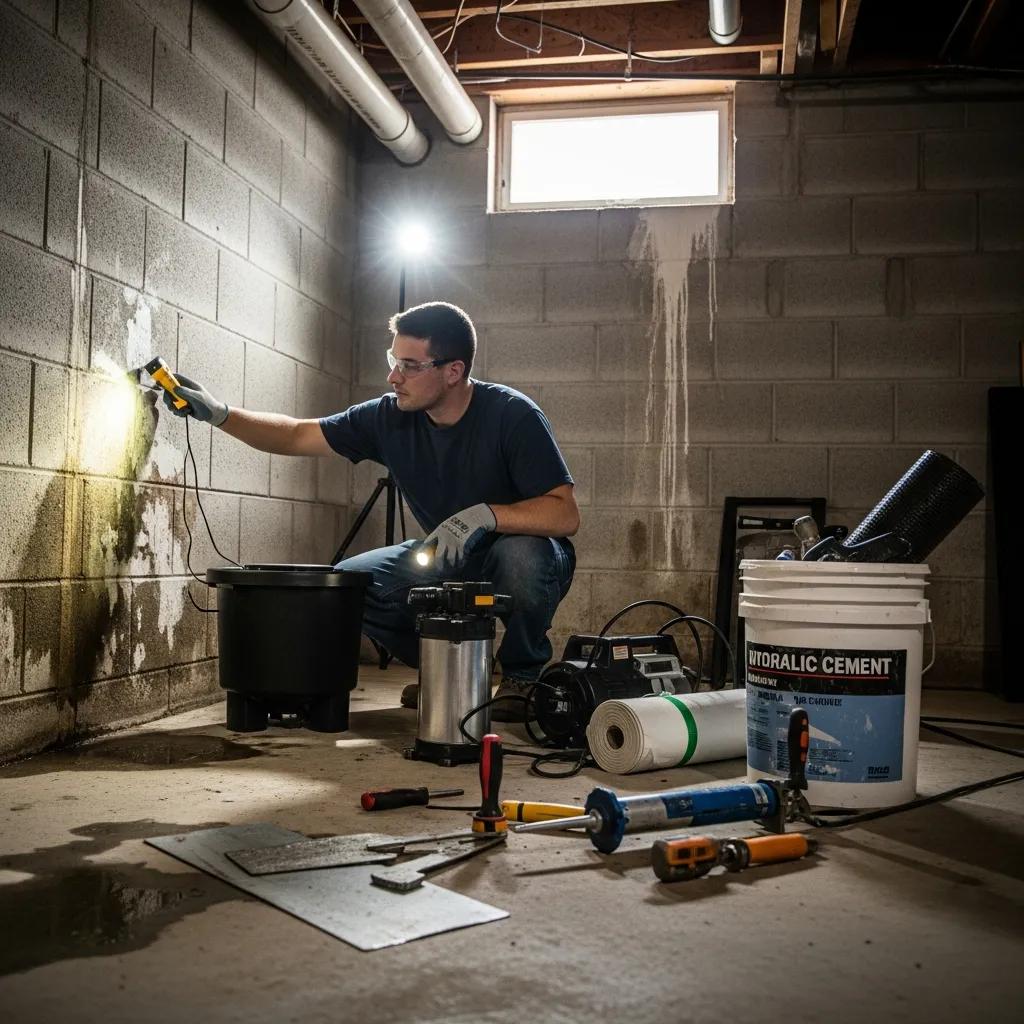
Basement water intrusion is any unwanted water entering below-grade space due to surface runoff, groundwater, plumbing, or condensation, and it damages finishes, supports mold growth, and raises hydrostatic pressure against foundations. In Union, NJ, common mechanisms include poor exterior grading that funnels runoff to foundations, high seasonal precipitation leading to a raised water table, clogged gutters that concentrate rainwater near footing lines, and lateral seepage through cracks driven by hydrostatic pressure. Homeowners should understand these mechanisms because stopping surface sources and relieving subsurface pressure require different solutions. The paragraph below provides an actionable checklist of visible and sensory signs that indicate intrusion and when to pursue professional inspection.
Homeowners can use this quick checklist to prioritize responses:
- Musty or mildew-like odors that persist even after airing out the space.
- White powdery deposits (efflorescence) on masonry walls and floors.
- Visible damp stains, peeling paint, or bubbling plaster on walls.
- Cracks in walls or floors with tinting or active water seepage.
- Standing water after storms or slow drainage after plumbing leaks.
These signs narrow down whether a problem is surface-runoff related, a plumbing leak, or groundwater intrusion, and they suggest next steps such as surface drainage correction or interior drainage systems. If multiple signs persist after simple fixes, scheduling a professional inspection is the logical next step to diagnose hydrostatic pressure or structural contributors.
How to Identify Signs of Basement Water Damage and Mold Growth
Visual, tactile, and olfactory cues help differentiate condensation, minor dampness, and active water intrusion; recognizing these differences guides repair urgency and method selection. Look for efflorescence as a sign of water migrating through masonry; efflorescence indicates mineral-laden groundwater movement, which often requires drainage or waterproofing. Mold patches that are fuzzy or black clustered areas paired with musty odor point to prolonged moisture and a potential indoor air quality risk that demands remediation. Physical checks include feeling walls and floors for dampness, observing staining patterns after rain events, and monitoring humidity with a hygrometer; persistent relative humidity above about 60% typically fosters mold growth. If you observe widespread mold or structural cracking with moisture, call a professional for a comprehensive assessment and remediation plan.
What Local Factors in Union, NJ Contribute to Basement Water Problems?
Local climate, soil composition, and lot-level conditions in Union, NJ increase the likelihood of water intrusion when combined with inadequate site drainage or aging plumbing. Union experiences seasonal precipitation patterns and storm events that can elevate the groundwater table and create sustained hydrostatic pressure against foundations, forcing water through cracks and porous masonry. Soil types with finer particles — clays and silts — hold water and reduce percolation, increasing lateral pressure; conversely, highly permeable soils can concentrate subsurface flow toward footings if grading is poor. Urban lot constraints and hardscaping such as driveways and patios can redirect runoff toward the house unless gutters, downspouts, and surface grading are maintained to divert water away. Understanding these local contributors helps homeowners select the right combination of surface corrections and subsurface drainage solutions to prevent recurring intrusion.
How Do French Drain Systems Prevent Basement Flooding and Hydrostatic Pressure?
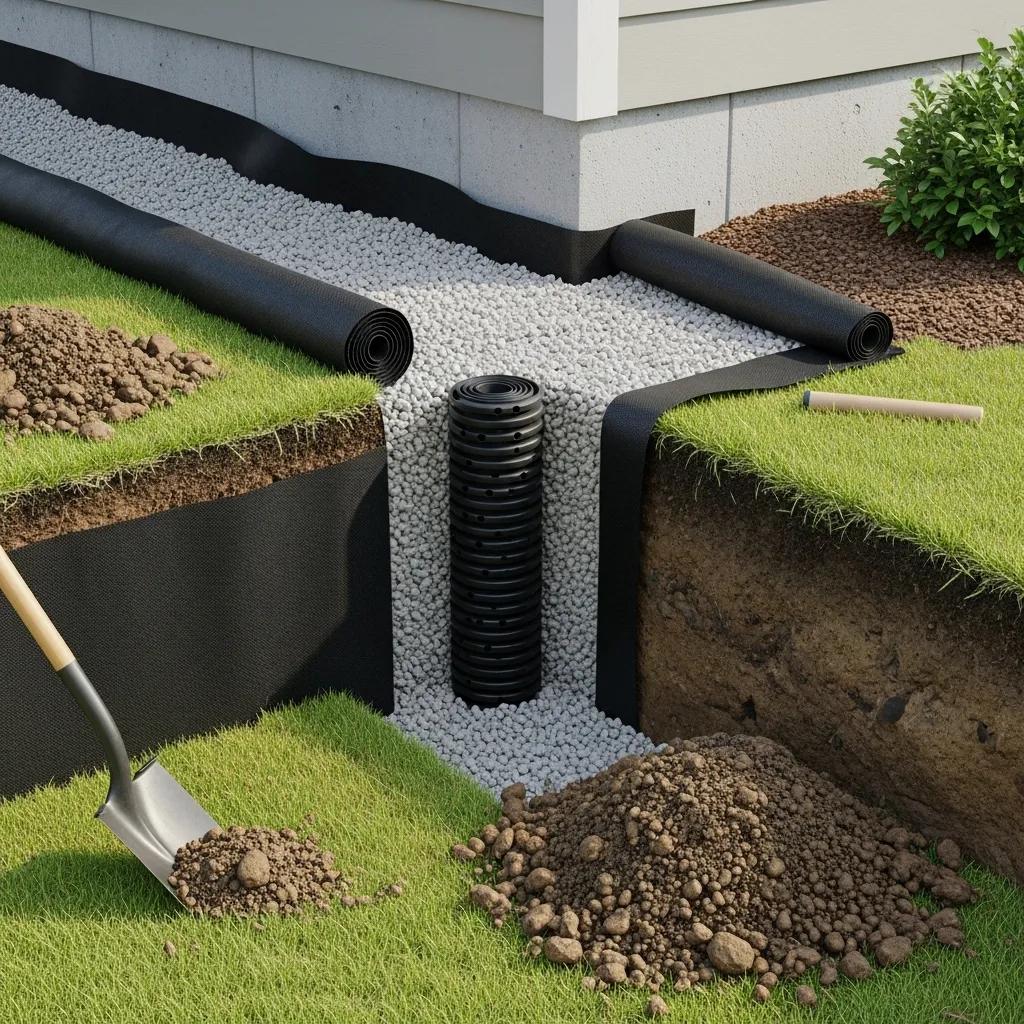
A French drain is a subsurface drainage solution that collects and redirects groundwater away from the foundation, reducing hydrostatic pressure and preventing seepage through cracks and porous materials. Mechanically, French drains relieve pressure by providing a low-resistance pathway — usually a perforated pipe wrapped in filter fabric and surrounded by gravel — that captures water migrating through soil and routes it to a sump basin or daylight outlet. By lowering the groundwater level near the foundation, the system reduces the driving force that pushes water through walls and floors, protecting finishes and minimizing mold risk. The following list summarizes core components and how they work together to control subsurface water and hydrostatic loads.
- Perforated pipe placed on a slope to move collected water toward a discharge point.
- Gravel or aggregate surrounding the pipe to promote flow and prevent clogging.
- Filter fabric to keep fine soil particles out of the drain media and pipe.
- Connection to a sump basin and pump or to a gravity outlet when available.
Choosing between interior and exterior French drains depends on soil conditions, access, landscaping, and whether the priority is stopping visible seepage or lowering the external groundwater level. The next subsections detail interior installation steps and the cost drivers homeowners in Union County should expect during quoting.
Introductory comparison: interior vs exterior French drains follows in the table below to clarify trade-offs, disruption levels, and typical cost ranges.
| System Type | Key Components | Typical Disruption | Typical Cost Range |
|---|---|---|---|
| Interior French Drain | Perforated pipe, gravel, filter fabric, sump connection | Concrete trenching inside basement perimeter; minor interior finish repair | Moderate to High |
| Exterior French Drain | Trench outside foundation, perforated pipe, gravel, landscape restoration | Significant exterior excavation and landscaping restoration | High |
| Perimeter Exterior with Gravity Outlet | Deep trench to daylight outlet, larger pipe | Major excavation; best where daylight discharge is possible | High to Very High |
What Are the Components and Installation Steps of Interior French Drains?
Interior French drain installation typically begins with mapping the perimeter then cutting a shallow trench along the basement floor to expose footing-level slab edges and create space for drain media. Installers place a filter fabric liner, add gravel bedding, position a perforated pipe sloped toward a sump basin, and backfill with more gravel before patching the concrete floor to maintain interior finishes. The pipe then ties into a sump pump system if gravity discharge is not possible, allowing collected water to be pumped away from the home. Maintenance expectations include keeping the sump pump tested, ensuring the pump discharge remains clear, and periodic inspections for sediment or clogging; timely maintenance preserves the system’s ability to relieve hydrostatic pressure.
What Are the Cost Factors for French Drain Installation in Union County, NJ?
French drain pricing depends on excavation difficulty, basement finishes to be restored, access limitations, pipe and aggregate quality, and whether a sump pump and battery backup are needed, with local permitting occasionally adding to cost. Labor intensity increases when installers must remove finished flooring, work in tight utility-obstructed perimeters, or perform concrete removal and replacement, which raises total project expense. Material choices — higher-grade perforated pipe, geotextile fabric, and washed aggregate — influence longevity and expense, while exterior systems add landscape restoration and potential curbside access logistics. For owners seeking an accurate estimate, a free inspection identifies specific drivers and yields a tailored proposal; for immediate concerns, calling to schedule an on-site evaluation is the recommended next step.
Which Basement Waterproofing Solutions Protect Homes in Union, NJ?
Basement waterproofing is a portfolio of solutions — interior drainage and sump systems, exterior foundation waterproofing, wall coatings, crawl space encapsulation, and humidity control — that together reduce water intrusion, mold risk, and foundation stress. Each option targets a different part of the water pathway: exterior membrane and grading stop surface water before it reaches footings, French drains and sump pumps manage subsurface groundwater, and encapsulation plus dehumidification control humidity and vapor migration in crawl spaces. Selecting the right combination depends on diagnostic findings, budget, and long-term performance goals; preventive strategies often combine surface corrections with subsurface systems. The following table compares common sump pump types and battery backup options so homeowners can weigh power-source resilience and maintenance needs.
| Pump/Backup Option | Power Source | Typical Lifespan | Typical Cost | Maintenance Needs |
|---|---|---|---|---|
| Submersible Pump | AC electrical main power | 7-10 years | Moderate | Annual test and float check |
| Pedestal Pump | AC electrical main power | 8-12 years | Lower initial cost | Annual inspection and motor maintenance |
| Battery Backup Unit | Rechargeable battery with charger | 3-5 years per battery | Moderate | Battery replacement every few years, periodic testing |
| Combination Backup (Battery + Water-Powered) | Battery and water pressure | Varies | Higher | Multi-system testing and upkeep |
How Does Sump Pump Installation and Battery Backup Prevent Flooding?
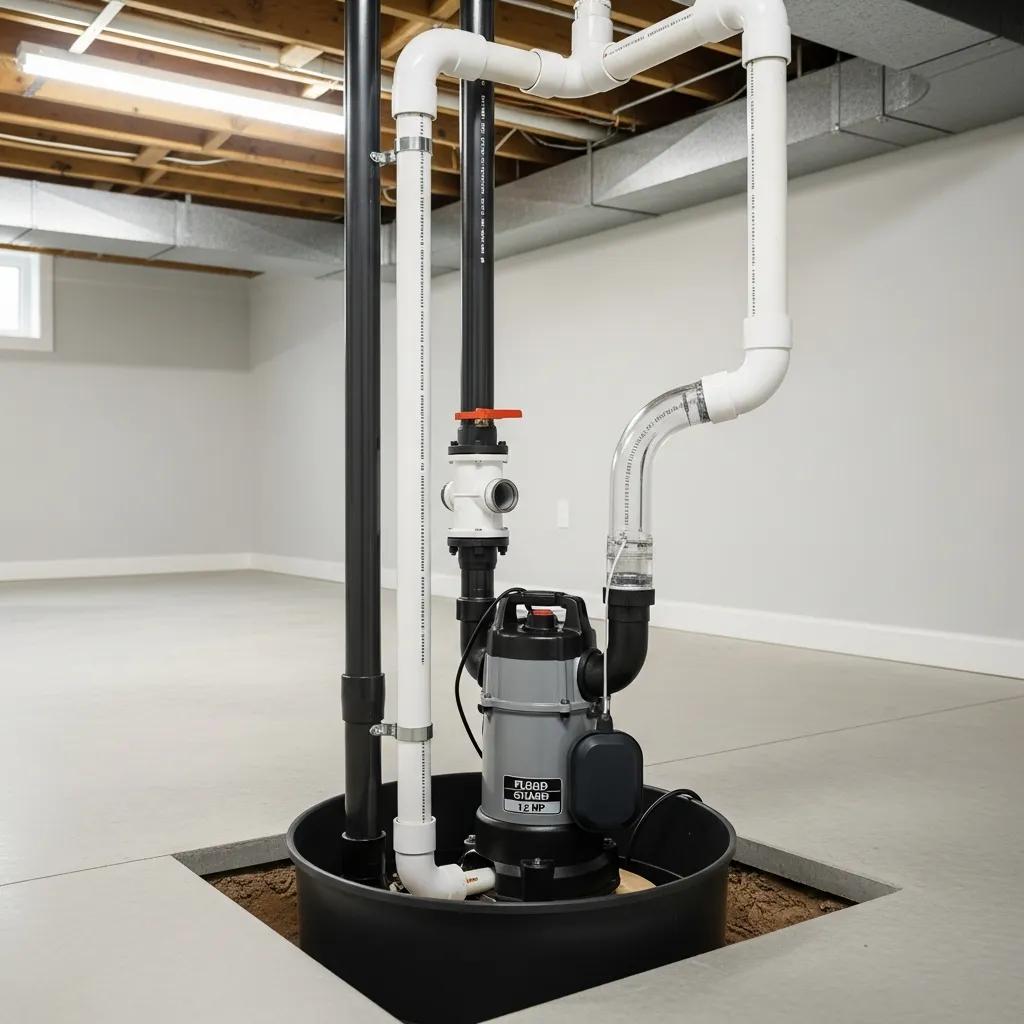
A sump pump removes collected groundwater from a basin and directs it away from the foundation, preventing accumulation that leads to flooding and reducing hydrostatic pressure on walls and floors. Submersible pumps sit inside the sump basin and automatically activate when water reaches a set float level, while pedestal pumps have the motor above the basin and are sometimes easier to service but more exposed. Battery backup units keep pumps operating during power outages — a critical redundancy when storms both increase water inflow and cause power loss — and combined backup strategies provide the highest reliability. Regular maintenance, including quarterly tests, float unobstruction checks, and battery replacements, ensures continued protection and should be part of a homeowner’s flood-prevention plan.
What Are the Benefits of Crawl Space Encapsulation and Dehumidification Systems?
Crawl space encapsulation involves sealing the ground and walls with a durable vapor barrier and insulating to block soil moisture and radon entry, while dehumidifiers maintain low relative humidity to prevent mold and wood decay. The encapsulation package reduces convective moisture transfer into living spaces, improves HVAC efficiency by stabilizing air exchange loads, and protects joists and subfloors from rot and pest attraction. Dehumidifiers sized for the crawl space maintain continuous humidity control and should be paired with monitoring to adapt to seasonal conditions; combined, these measures improve indoor air quality and energy performance. The next section connects water intrusion to underlying foundation problems and explains repair approaches that address both moisture and structural integrity.
How Can Foundation Repair and Structural Reinforcement Address Basement Issues?
Foundation problems — cracks, bowing walls, and settlement — create pathways for water and exacerbate intrusion by changing load paths and opening new seams in masonry or concrete; structural repairs restore both strength and water resistance. Techniques range from crack injection (epoxy or polyurethane) to stitching and anchoring systems for bowed walls, helical piers for settled footings, and carbon fiber straps for moderate lateral movement. Repair choice depends on crack type (active vs. dormant), wall movement degree, and whether soil conditions continue to apply pressure; combining structural reinforcement with drainage solutions often produces the best long-term results. The following subsections describe common crack repairs and the role of carbon fiber straps in stabilizing bowed walls.
What Techniques Are Used for Foundation Crack Repair in Union, NJ?
Foundation crack repair methods include epoxy injection for structural re-bonding when cracks are stable, and polyurethane injection for flexible water-stopping when the crack is active and leaking; the method selected depends on the crack’s movement and moisture condition. Epoxy injections restore tensile capacity across cracks, making them suitable for structural repair where movement has ceased, while polyurethane foams expand to seal leaks during active seepage by reacting with water. For larger or recurring problems tied to settlement, underpinning using piers or pressure grouting may be necessary to stabilize and transfer loads to competent soils. Post-repair monitoring and addressing external drivers like grading and drainage are essential to prevent reactivation of repaired cracks.
How Do Carbon Fiber Straps Reinforce Bowing Basement Walls?
Carbon fiber straps provide a low-profile, high-strength reinforcement that bonds to the interior face of masonry or concrete walls to resist further lateral movement with minimal excavation or disruption. The straps act as tensile elements that pull the wall back toward plumb or prevent additional bowing by transferring loads into a stable substrate; installation typically requires surface preparation, epoxy bonding, and periodic inspection. Carbon fiber is advantageous where movement is moderate and cost or site constraints make anchor systems less desirable, but straps are not appropriate for walls requiring significant structural correction or where soil pressure must be relieved externally. Choosing straps versus anchors hinges on engineering assessment of wall behavior, and straps are often part of a broader program that includes drainage and moisture control.
Why Choose Effective Basement Solutions for Waterproofing Services in Union, NJ?
Effective Basement Solutions provides local basement waterproofing services focused on protecting homes from water damage, mold, and foundation issues, offering licensed in-house crews, free inspections, and post-installation support to reduce homeowner risk. Their value propositions include quality control through in-house labor (no subcontractors), a diagnostic-first approach via complimentary inspections that identify root causes, and integrated solutions spanning French drains, sump pumps, crawl space encapsulation, and structural reinforcement. These elements lower the likelihood of recurring problems because the company combines site-specific diagnostics with systems designed to address both surface and subsurface water paths. Homeowners considering a contractor should confirm licensing, warranty scope, and whether crews are direct employees — Effective Basement Solutions lists licensed in-house crews and free inspections as core differentiators.
What Are the Company’s Unique Value Propositions and Local Expertise?
The company emphasizes licensed, in-house crews to maintain consistent workmanship and quality control rather than relying on subcontractors, which improves accountability and continuity across inspection, installation, and warranty service. Free inspections let technicians evaluate grading, guttering, basement finishes, and foundation condition to recommend the most effective combination of drainage, waterproofing, and structural repair tailored to Union, NJ properties. Service offerings include interior French drain installation, sump pump systems with backup options, crawl space encapsulation, and dehumidification, giving homeowners access to integrated solutions without managing multiple contractors. This localized expertise helps translate diagnostic findings into prioritized actions that address both immediate leaks and underlying drivers.
How Do Customer Testimonials and Free Inspections Build Trust?
Customer testimonials and documented before/after photos reduce buyer uncertainty by demonstrating outcomes and reliability, while free inspections provide transparent diagnostics and a written proposal that clarifies scope and expectations before work begins. Collecting and presenting testimonials paired with documented inspection reports helps homeowners verify performance and understand typical timelines, disruption levels, and warranty coverage. During a free inspection, technicians should outline observed issues, recommended remedies, cost drivers, and maintenance responsibilities so homeowners can compare proposals and spot unreasonable quotes or missing scope items. For urgent or complex moisture problems, scheduling a free inspection and getting a written estimate offers the clearest path to resolving the issue with confidence; homeowners can call 18009570075 to arrange an evaluation.
What Are the Typical Costs and Financing Options for Basement Waterproofing in Union, NJ?
Cost for basement waterproofing projects varies by scope, system type, access, and finishes affected, with factors such as basement square footage, required excavation, sump pump selection, and structural repairs driving price ranges. Typical local price drivers include labor intensity for interior trenching and concrete replacement, landscape restoration for exterior work, materials quality for piping and membranes, and any necessary permits or engineering reports. Financing options often include in-house payment plans or third-party financing that spreads cost over time, and warranties commonly cover workmanship and specific components like pumps for defined durations; homeowners should request written warranty terms during bidding.
Below is a cost-driver breakdown to clarify what influences pricing:
| Service Component | Cost Driver | Sample Range or Impact |
|---|---|---|
| Interior French Drain | Trenching depth, concrete repair, sump pump add-on | Moderate to High |
| Exterior Drainage | Excavation, landscaping restoration | High to Very High |
| Sump Pump System | Pump type and backup inclusion | Moderate |
| Foundation Repair | Crack method, underpinning needs | Moderate to Very High |
| Crawl Space Encapsulation | Vapor barrier quality, insulation, dehumidifier | Moderate |
How to Estimate Basement Waterproofing and French Drain Installation Costs?
Homeowners can form a rough estimate by listing key variables: basement square footage, presence of finished floors requiring restoration, accessibility for excavation, visible structural issues, and whether a backup sump pump is desired. Sample scenarios might include a small unfinished basement needing an interior French drain and basic sump pump (lower-range cost), a finished basement requiring careful floor restoration and higher labor (mid-range), and an exterior trench to daylight with landscaping restoration or underpinning (upper-range). Obtaining multiple quotes and confirming included line items — concrete patching, disposal, permits, warranties — helps identify outliers and avoid surprises. Scheduling a free inspection yields a site-specific estimate that accounts for all these variables and highlights necessary trade-offs.
What Financing and Warranty Options Are Available to Homeowners?
Financing commonly comes from in-house payment plans or third-party consumer financing that spreads payments over months or years; available options vary by contractor and credit qualification. Warranties typically separate workmanship from component warranties — for example, a workmanship warranty on installed drains and a manufacturer warranty on pump motors — and homeowners should request written terms that specify duration and coverage. Verifying warranty transferability, service response times, and what maintenance is required to maintain coverage are important steps before signing a contract. For specific financing offerings and warranty details tailored to your project, contact the company directly at 18009570075 to discuss options and request a written proposal following a free inspection.
Frequently Asked Questions
What is the difference between interior and exterior French drains?
Interior French drains are installed within the basement to collect and redirect water that seeps in, while exterior French drains are placed outside the foundation to prevent water from reaching it. Interior systems typically involve trenching and may require minor repairs to the basement floor, whereas exterior systems involve significant excavation and landscaping restoration. The choice between the two depends on the specific water intrusion issues, soil conditions, and homeowner preferences regarding disruption and cost.
How often should I maintain my sump pump system?
Regular maintenance of your sump pump system is crucial for ensuring its effectiveness. Homeowners should test the pump at least once every three months by pouring water into the sump pit to see if it activates. Additionally, it’s advisable to inspect the discharge line for blockages and ensure the float switch is unobstructed. Annual professional inspections can also help identify potential issues before they lead to failure, especially before the rainy season when the risk of flooding increases.
Can I install a French drain myself, or should I hire a professional?
While some homeowners may attempt to install a French drain themselves, it is often recommended to hire a professional due to the complexity of the installation and the need for proper grading and drainage calculations. Professionals have the experience and tools to ensure the system is installed correctly, minimizing the risk of future water issues. Additionally, improper installation can lead to costly repairs down the line, making professional help a worthwhile investment.
What are the signs that my basement waterproofing system needs repair?
Signs that your basement waterproofing system may need repair include persistent dampness or musty odors, visible water stains on walls or floors, and the presence of mold or mildew. Additionally, if you notice cracks in the foundation or walls, or if your sump pump frequently runs without heavy rainfall, these could indicate that the waterproofing system is not functioning effectively. Regular inspections can help catch these issues early and prevent more extensive damage.
How long does it typically take to install a French drain?
The installation time for a French drain can vary based on several factors, including the type of drain being installed (interior vs. exterior), the size of the area, and site conditions. Generally, an interior French drain can be installed in one to two days, while an exterior French drain may take two to four days due to the need for excavation and landscaping restoration. Homeowners should consult with their contractor for a more accurate timeline based on their specific project.
What financing options are available for basement waterproofing services?
Many contractors offer various financing options for basement waterproofing services, including in-house payment plans and third-party financing. These options allow homeowners to spread the cost over time, making it more manageable. It’s important to discuss financing terms with your contractor, including interest rates, payment schedules, and any potential fees. Additionally, some companies may offer promotional financing options during certain times of the year, so it’s worth inquiring about current offers.
How can I prevent future water intrusion in my basement?
Preventing future water intrusion in your basement involves a combination of proper drainage, regular maintenance, and monitoring. Ensure that gutters and downspouts are clear and direct water away from the foundation. Maintain proper grading around your home to divert surface water. Regularly inspect and maintain your sump pump and French drain systems. Additionally, consider encapsulating crawl spaces and using dehumidifiers to control humidity levels, which can help prevent mold growth and moisture issues.
Conclusion
Implementing effective basement waterproofing and French drain systems in Union, NJ, significantly reduces the risk of water intrusion, mold growth, and structural damage. Understanding the local factors and available solutions empowers homeowners to make informed decisions that protect their investments. For tailored recommendations and a free inspection, reach out to our expert team today. Take the first step towards a dry and secure basement by contacting us now.
Sub Zero and Wolf Appliance Repair Chicago is the expert for all types of appliance repair in Chicago, IL. We service Sub-Zero and Wolf appliances, refrigerators, freezers, dishwashers, washers, dryers and more.211 characters