
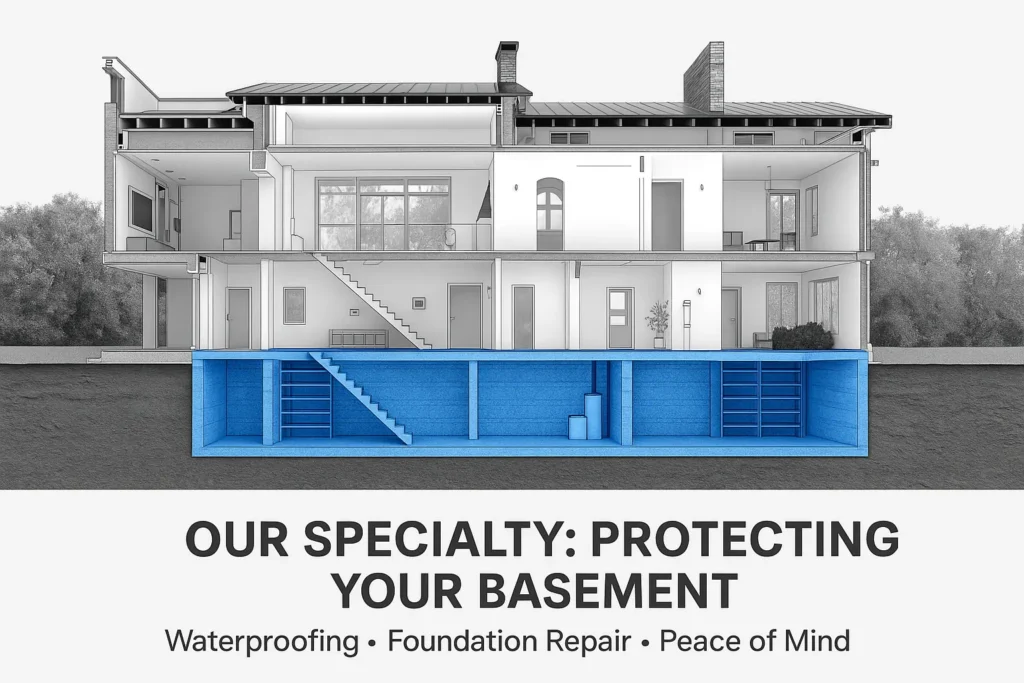
The Wet Reality: New Jersey Basement Water and Sewer Issues
New Jersey basement water and sewer issues are becoming more common in low-lying neighborhoods across Union County, Morris County,
Essex County, and surrounding areas. When heavy rain overwhelms storm seepage systems and tired sanitary sewer lines, groundwater rises and pushes
moisture into foundations. That same pressure can also pull in sewer gas, radon, and mold spores. This guide from
Effective Basement Solutions explains what’s really going on under your house, how to spot early warning signs, and how to protect
your basement before there is major structural damage.
Understanding New Jersey Basement Water and Sewer Issues
Many New Jersey homes sit above overlapping systems: storm seepage piping, sanitary sewers, and natural groundwater movement. When these systems
slow down, fail, or crack, the water table rises. Basements then deal with seepage, damp air, and sometimes direct backup. You may notice any
combination of three problems at the same time: persistent dampness, periodic flooding, and sewer odor. None of that is “just normal.” Those are
early warnings.
Part 1: Where the Water Comes From
1) Storm Seepage Systems and Rising Groundwater
Storm (seepage) lines are supposed to move rainwater toward streams and rivers. Over time, inlets and underground runs fill with leaves, grit,
and sediment. When that flow slows, stormwater sits in the soil instead of draining away. That makes the ground around your foundation stay
saturated for days.
Once soil is saturated, groundwater rises and pushes against your basement walls and basement slab. That is called hydrostatic pressure.
Hydrostatic pressure does not wait for a visible crack — it finds weak points in block cores, floor joints, and any gap in the cove (where the wall
meets the floor). This is a major driver behind repeat “mystery leaks.”
Key point: Slow storm drainage = constantly wet soil = pressure on your foundation even when it’s not actively raining.
2) Sanitary Sewers and Groundwater Infiltration
Sanitary sewers carry wastewater to treatment plants. Many older New Jersey neighborhoods still have clay or concrete sewer laterals. Those lines
crack, shift, or separate with age. During rain events, elevated groundwater slips into those cracks and overloads the sanitary system.
When the system is overloaded, pressure can reverse. That means wastewater can come back toward your property through low fixtures or
basement floor drains. In extreme cases it can reach first-floor fixtures. If you’ve ever smelled sewer odor inside the sump pit or noticed black,
dirty water pushing up through a floor drain after a storm — that is not normal. That is a sanitary backup risk.
Key point: Cracked sanitary lines + high groundwater = possible sewer backup into the home.
3) Groundwater Movement and Capillary Action
Water does not need an open hole to get in. Through capillary action, moisture wicks through concrete, mortar joints, and cinder block.
The hollow cores inside block walls can fill like little water channels. You may not see liquid water on the floor, but the wall behind your finished
drywall is humid, musty, and feeding mold.
Typical signs include white mineral residue (efflorescence), bubbling paint on lower walls, and a “damp basement smell” that never totally goes away.
Part 2: What That Water Does to Your Home
4) Mold and Indoor Air Quality
Moisture trapped in walls, base plates, and floor framing creates perfect conditions for mold growth. Mold does not need standing water — it just needs
steady moisture and organic material like wood or paper facing on drywall. Common red flags: musty odor, peeling or bubbling paint near the floor,
stains on trim, recurring condensation on basement windows or ductwork.
To control mold risk, you want relative humidity below 55% in the basement, continuous air movement, and a waterproofing system that keeps the slab and
footing area dry instead of constantly re-wetting.
5) Radon and Pressure Changes
Radon gas travels up through tiny openings in the slab, the sump pit, and foundation cracks. Changing water pressure under the house changes how that
gas gets drawn inside. When groundwater is high, pressure under the slab shifts — that can actually increase the pull of radon indoors.
Radon tests done with windows open are often misleading and read artificially “low.” Real testing is closed-home testing. You should also retest radon
after any waterproofing or structural work, because you’ve literally changed how air moves under and through the house.
6) Foundation Stress and Structural Movement
Wet, heavy soil pushes sideways on foundation walls. Over time that steady load can create horizontal cracks, bowed walls, minor footing movement,
or gaps that allow even more water and soil gas to enter.
Early clues: basement wall cracking at the mortar joints, step-pattern cracks, a slight curve or bow in the wall when you look down its length, first-floor
doors that suddenly rub the frame, or hairline drywall cracks above door and window corners.
Part 3: Practical Action Plan for New Jersey Homeowners
- Keep storm inlets clear: Before heavy weather, clear gutters and (if allowed in your town) clear leaves around nearby street grates so water can move.
- Confirm sump discharge routing: Your sump pump should never discharge into a sanitary sewer line. It should go to an approved storm outlet, dry well, or safe surface discharge.
- Watch for sewer indicators: Repeated basement drain backup or sewer odor in the sump pit = schedule a sewer camera inspection immediately.
- Control humidity: Use a hygrometer and keep basement relative humidity under 55%. Run a reliable dehumidifier or a dedicated air system year-round, not just in summer.
- Test radon properly: Closed-home protocol. Retest after waterproofing, drain work, crack repair, or foundation reinforcement.
- Inspect seasonally: Look for new efflorescence, damp corners, rusted fasteners at the bottom of framed walls, or repeating moisture rings on the floor.
- Do not finish over a damp wall: Never frame, insulate, and drywall a foundation wall that’s still testing damp. You will trap moisture and feed mold.
How We Solve New Jersey Basement Water and Sewer Issues
Effective Basement Solutions designs systems to address
New Jersey basement water and sewer issues at the source. Our installations are done by our own trained crews (no subcontractors),
and every project is built around what your house is actually dealing with.
- Interior French Drain System: We open the perimeter at the footing, install perforated pipe and clean stone, and direct water into a sealed sump basin instead of letting it push through your floor.
- High-Capacity Sump Pump: Zoeller / Liberty professional-grade pumps with proper discharge, not a cheap box-store unit that burns out mid-storm.
- Battery / Water Backup Pumps: Keeps pumping during power outages. Critical for towns that flood hard.
- Sewer Backflow Prevention: Check valves and backwater valves that stop municipal surges from entering your basement drains.
- Carbon Fiber and Structural Reinforcement: Stabilizes bowing or cracking foundation walls caused by long-term lateral soil pressure.
- Dehumidification and Air Quality Control: We manage moisture and air, not just the visible water line on the floor.
When to Call a Professional
- You’ve had any sewer backflow or consistent sewer odor
- Your basement wall is cracking, bowing, or leaning
- You still get water during storms even though you already have a sump pump
- Radon test levels changed after drainage work
- Your finished basement smells damp or musty and you can’t find where it’s coming from
Summary
New Jersey basement water and sewer issues are not just “a little water.” Storm seepage, sanitary sewer leaks, rising groundwater,
air quality, radon, and foundation stress are all connected. If you catch the warning signs early — damp corners, sump odor, hairline cracking,
humidity over 55% — you can prevent expensive damage, protect air quality, and keep your lower level usable and safe.
About Effective Basement Solutions
Effective Basement Solutions is a licensed New Jersey waterproofing and structural repair company based in Clark, NJ.
We specialize in interior French drain installation, sump pump systems, sewer backflow prevention, crawl space encapsulation, mold remediation,
radon-conscious waterproofing, and foundation wall stabilization. We proudly serve Clark, Cranford, Westfield, Summit, Short Hills, Millburn,
Springfield, Madison, Florham Park, and the surrounding North / Central New Jersey area.
Call: 1 (800) 957-0075
Email: [email protected]
Website: https://effectivewaterproofing.com
License: #13VH06363800 · 321 New York Ave, Clark, New Jersey 07066
Published by Effective Basement Solutions · Clark, New Jersey · Homeowner Education / Community Information
Tagged: Clark NJ basement waterproofing, Cranford NJ basement waterproofing, Westfield NJ sump pump, Summit NJ foundation repair,
Short Hills NJ mold remediation, Union County NJ waterproofing.
